Category Archives: Articles/reviews

Elizabeth M. Castillo’s “Cajoncito”–The Many Poetrys in Which “Love, Loss y Otras Locuras” [Love, Loss and Other Follies] Speak

The front cover of “Cajoncito: Poems on Love, Loss y Otras Locuras” in paperback, by the author.

     Cajoncito [A Little Drawer]:  Poems on Love, Loss y Otras Locuras [and Other Follies]” is a book of remarkable poetry by Elizabeth M. Castillo, a British-Mauritian poet living in Paris with her family, who has also lived before in Chile, Mauritia, and the DRC.  She is widely published in various languages in which she composes, notably English, Spanish of two countries, and French.  My introduction to a smattering of her poetry in English two years ago was through Twitter, where I first encountered her work.  At long last, when her second book, Not Quite an Ocean is now out and being read, I find the first still holding its own in the warp and woof of my poetic memory (to use an artistic image as much as possible in the manner of the ones I admire in her work).  The first book is a tribute as well to her life with numerous other people whom she has loved, and some of whom she has lost.

     Her artistic words are ordinary and simple if multitudinous and mightily creatively used words for passion, and feeling.  Not only do words in English and Spanish–only the first of which I came to the work knowing more than a smattering of–respond easily and richly to her call, but they say things, visit emotional places one may have felt, but never known how to have put in one’s emotional passport legally.

     The territories and lands of the transgressions against love and the grief resulting, as well as grief and longing drawn from other sources crafted for life, are painted here in vivid language colors, sometimes in matched, paired poems in which some words of Spanish in one and English in the other are reversed, sewing the two bright place languages together like the covers of a book of poetry.

     There is too much to quote, too many inspirations to follow down the corridors of the heart of this poet’s work:  you have to read it for yourself.  Before, I have always been a curious but casual peruser of the Spanish version of the English bus and other public announcements on American walls and ceilings, attempting in my primitive way to match the correct pairs of words.  For the first time, but I hope not last, I meet the natural aristocracy of someone’s language who has mastered both, and who can vary them back and forth easily at will, making of them in her matched sets of poems a wife and husband completing each other’s sentences, interrupting, interjecting, but always in complete agreement for the reader, who only has to locate the translated portion in the matching poem to learn “for sure” what the “foreign” phase or sentence means.  And learning in any way at all is always lovely.  And it’s there that the virtue and smugness of “knowing for sure” is also trickily understood in all life ventures to be a form of foolhardiness and loss except in love with life and language, which have in some way to make their declarations of certainty for the time in spite of really not knowing, as the poet more or less outright states she would have it.  I find that I almost begin to understand instinctively portions of the Spanish from this gentle and loving example of what used to be called “immersion” learning, as if in the hands of a dedicated and talented tutor or teacher.

     Castillo’s major poetic virtue, and she has many, is thus her comprehensive expressiveness and rich texture of images and references to simple enough things about life that become complex again as she puts them in words.  One feels almost as if one oneself is becoming gifted enough to understand a new and alien language about life and its doings and “loves, losses, y  otras locuras” (as she puts it in her title).

     Finally, the greatest reader’s gratitude I have for Elizabeth M. Castillo as the author of the book is that she makes me stretch myself and my own experiences over the framework of her embroidery hoop to be needled and pierced by her lovely work, a set of images and feelings that I never knew I needed so badly before she created them.  Please buy this book and read it soon, and then buy Not Quite an Ocean to see what she is doing!

8/5/23, by Victoria Leigh Bennett (shadowoperator)

Leave a comment

Filed under Articles/reviews, Poetry and its forms and meanings, Topical poems--Covid-19, What is literature for?

How a Debut Book of Poetry Dedicated “For Dad” Has Come to Be “For Everyone”–Lawrence Moore’s “Aerial Sweetshop”

The cover of Lawrence Moore’s “Aerial Sweetshop,” published by Alien Buddha Press.

     Lawrence Moore, who has quite a bit of recent work published in a number of reputable and well-respected places such as Indigo Dreams and Dreich Magazine, and whose Twitter handle is known by many as simply @LawrenceMooreUK, is frankly unassuming as are many poets, and has patiently waited a year exactly for this much-deserved review, while the reviewer dealt with life and its turmoil.  I am delighted at last to be able to bring it to my readers.  Aerial Sweetshop, though dedicated as a devout tribute “For Dad,” a flyer of planes both full-scale and model, is actually an experience for every poetry reader, whether a rhymed verse addict (where Lawrence’s work shines) or one of those who prefer blank/free verse.

     Moore’s verse is one distinguished in substance by melodic, singing rhythms even when not in rhyming verse, and by kind and altruistic notions.  Its subjects are those of mysteries and magic, love poems, and always the sky, and looking up and flying (in both of their literal and metaphorical meanings).  Its images are drawn from changing landscapes, the landscapes (when not of pure sky) both actual and even more often those of pure imagination, metaphorical landscapes.  The loving rhetoric is one of both faith in a single companion’s human goodness, as well as in the charms and chances of harmless mutual mischief.  The villains of the piece are responsible for submerged notes of fear of prejudice and unjust punishments, but are overcome by the claims of gentleness and the strength of togetherness.  The one exception (and I’m not sure the female figure leading the narrrator in “My Ardent Friend” can actually be called a villain, in any plain sense) is one who leads on to a sort of accepted ritual or initiatory ending, which is not exactly an ending.  Ah! A curious mystery to lead us in and on!

     There is a temptation with the rhymed poems, because some of us have grown up familiar with or at least exposed to end-rhyme poetry, to jog-trot the wonderful meters and jar the end-rhymes, but in both the other poems, the blank/free verse poems and the rhymed ones, the rhythms change sometimes unexpectedly and stop that bar to good poetry from taking place.  In those cases, if you get too caught up in the sound, you risk missing startlingly lovely and human senses in the poems, such as:

1). p. 9–“don’t let the busybodies ask you why/when they mean don’t…”

2). p. 26–“and if you snore all day/and talk while chewing on your food…”

3). p. 39–“The big wide world is interesting;/you are my greatest adventure.”

     All in all, this chapbook is so worthwhile that it hardly seems a first effort at publishing poetry.  It contains most nobly, generously, and lovingly a poetry that makes its own happiness, with the inclusion often of a pertinent and essential “other,” a rescuer, guide, and companion in the pieces.  In conclusion, Moore’s book is a true “aerial sweetshop,” or as an American like me would perhaps put it, a “heavenly candy store,” full of all the sublime things and beings the heart most wants to have.

8/5/2023, Victoria Leigh Bennett (shadowoperator)

Leave a comment

Filed under Articles/reviews, Poetry and its forms and meanings, What is literature for?, writers of the LGBTQ+IA2 community

The Quiet But Resounding Pleasures of Wisdom–Alex Guenther’s “sonnets from the dhammapada”

     In his marvelous collection of sonnets on Buddhist thought, inspirations, and images, sonnets from the dhammapada, the impressive and practiced sonneteer Alex Guenther applies some of fthe same methods, skills, and sensitivity as he consistently does in all his sonnets.  A main difference here is that, as he credits in his introductory pages, he is drawing on other works of translation of Buddhist teachings, most notably that of Gil Fronsdal, with whom he feels a great sympathy and in whom he senses a kindred spirit, as he records.  But the rest is all his.

     Guenther–as he has done in his previous two books, the deodar seeds and the heave, which I have fortunately had the opportunity and privilege to read and review, and as he has continued to do in his later collections and his multitudinous and multifarious daily output, many of which I have been lucky enough to encounter as he has tweeted/posted them on Twitter–is an entirely and shockingly unique artist, but a great one.

     He reaches for a topic and topics aplenty he finds to hand, relating as always to the Buddhist practices, virtues, and outlook, which non-practitioners may find strange or alien to things already familiar and known or perhaps contemplated by those of them in his audience.  By this method, making the strange or unusual more familiar and understandable, he shows how great a teacher he really is, in a belief system full of great teachers, for this is his belief system as well as the source of his own inspiration.  It is not surprising to learn that he is also a literal and down-to-earth teacher of young people in “real life” as well.

     In his teaching by sonnet, Guenther brings clarity to any obscurities in Buddhist thought (for example, his sonnets among the “26 Pali chapters” which he calls “the most well-known Buddhist text” are: “filters” through which we construct our realities, “awareness,” human vagaries of thought, foolish people and their opposite, the making of “the wise,” “evil,” “violence,” “old age,” “the self,” “the world” in both the physical and social senses, “happiness” “pleasure,” “anger,” “the just,” “corruption,” “the path” (as in “the way”), “hell,” “the brahmin,” and images important to the original writers, such as “flowers” and “elephants.”

     In addition to being a steadfast believer and teacher of Buddhist thought, however, Alex also teaches by example in his wonderful and extremely talented and innovative usage of the Petrarchan sonnet, just as he has done before, and continues to do in many varied ways.  He has massively and manifestly increased the territory of the sonnet form by his general use of diverse and attention-getting, witty, original rhymes; his non-end stopped lines that spill over into the next line by sense, thus making the reader read for this sense and significance more than for a dogtrot sound; and the vast, encyclopedic knowledge he shows not only of people, but of the world and its scientific, artistic, architectural, and natural biological properties.  Alex Guenther maintains in his daily life quite obviously a system of keeping up his own learning through his curiosity and willing approach to what the world puts before us that can be learned.

     In concluding this review essay, it could well be said of Alex Guenther as of another–modest, unassuming but quite ambitious to find, celebrate, and share wisdom wherever it may be–the Clerk of Chaucer’s Canterbury Tales–and here I translate from Middle English into Contemporary English:  “And gladly would he learn, and gladly teach.”  We need so many more Alex Guenthers, poets, teachers, and explorers!

     Alex lists as “additional info and links” in his book, these:                                                                                                                                                                                                                                                         alexguentherpoetry.wordpress.com, twitter.com/guentheralex [@guentheralex], facebook.com/alex.guenther.104, instagram.com/guentheralex.

     I think he also is on substack (you can query him at twitter), and has been on Mastodon at least previously as @guentheralex@mastodon.social.

     Come learn somthing significant and worthwhile in beautiful and well-crafted language!

This review by shadowoperator (Victoria Leigh Bennett)


Leave a comment

Filed under Articles/reviews, Poetry and its forms and meanings, poetry as societal witnessing, What is literature for?

A.S. Byatt and Professor Jeffers–My Essay on Their “Big Historical Books” That Can’t Seem to Find a Publisher (Here It Is)

Some time back, I revised an essay on A.S. Byatt which I had written some years ago because at last I had found another book which I find equal and commensurate to it in stature and able not only to carry on the tradition Byatt established but to ring such changes on it as need to be rung for a different society and such disparate traditions in this country as need urgently to be united. On the basis of having read about 100 pages of Professor Jeffers’ book The Love Songs of W. E. B. Du Bois, I presumed to decide that this was the proper “inheritor” of the tradition Byatt had written in. There may possibly have been some inequity in the fact that I had not finished Professor Jeffers’ book, but I am continuing to read and will naturally do a full review on it when I have been able to finish, as I do with every book of stature which I have an opportunity to read. In my own defense, I would offer such personal facts as that I have also been reviewing other works recently, some of which I took up before Professor Jeffers’ book, others of which were easier to proceed with due to the simple fact that, whether prose or poetry, they were shorter. Also, I am almost certainly going to be forced to move before Christmas or shortly thereafter, and I have been getting ready and packed for that, and have been looking for Senior Housing. Perhaps I should have waited, but I was so eager to share the insight that I went ahead and revised the essay to include the prediction, no, the insistence, that the United States now has a book (there may somewhere be another, but this one is truthful about so many things, and it is a book of our contemporary centuries, too).

This book seems to me, at least, to be not only as enjoyable as Byatt’s book (all mysteries to end soon, I promise), but to be as informative if not more so, and as representative of a people’s culture, whether one is discussing that of the African-American citizens of this country or of our country as a whole, because it doesn’t leave the country alone and hanging, but speaks well for our culture as a cultural artefact. We should be just as proud of it as the British are of Byatt’s book (here it is), The Children’s Book, which only has as much to do with children as any historical book does, as it is a great deal more about the history and mores of the time. I have peeked ahead into Professor Jeffers’ book, but I didn’t want to do this too much before I wrote my final article to come in the future, because I didn’t want to take the risk of possibly issuing a spoiler and ruining it for the many readers who are still reading around me, as I don’t want to hear ahead of time either. And, this book also has a group of children as main characters. I say this in a certain amount of bewilderment as to why I haven’t been able to publish this article, aside from whatever my own skill with words may or may not be, which I leave to my readers. It may only be one of a host of other essays about the new book from a better variety of writers, or perhaps the difficulty has to do with simple editorial lack of space in previously committed journals. I don’t know. But I feel I don’t want to wait longer to cast my vote for the new book, always bearing in mind that I will review it again at better length later on.

It has occurred to me, that even in the two or three revisions this essay has gone through, I may be guilty of some oversight or intellectual injustice. If so, I am willing to hear the fault, from whomever feels they are qualified to tell me what it is. I want to know if I am in the wrong, because these are important issues: the societal issues raised about the status and well-being of a young black citizen and her family and associates in the United States are just as important as the looming issue of WW II was in Byatt’s book, and in my reading judgment are as well and interestingly handled. So, here is the essay: I invite comment, as always. [Thanks to D. L. Keur of the now defunct online journal thedeepening.com for printing the first version of the original Byatt essay, and for original permission to reprint.] Shadowoperator (Victoria Leigh Bennett)

3 Comments

Filed under A prose flourish, Articles/reviews, fiction examining societal inequities, What is literature for?

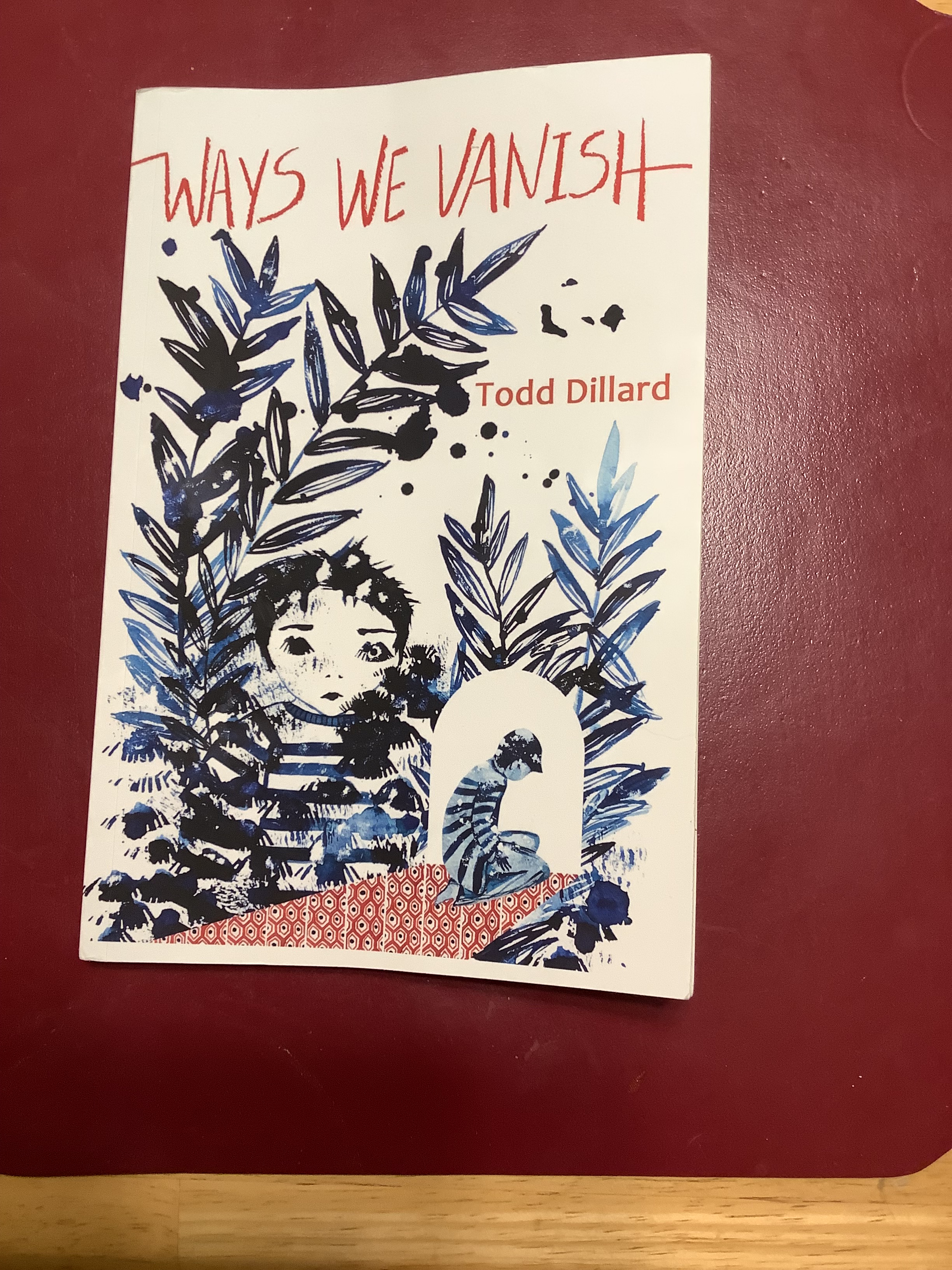
Todd Dillard’s book “Ways We Vanish,” and How We Can Find Ourselves Again in Its Pages

Todd Dillard’s book “Ways We Vanish,” published by Okay Donkey, Cover Art: Sarah E. Shields

One of the hardest things for a reviewer to do is to select out the particular and most essential things which set any work apart from others within even just our own memories, or to perhaps find adequate words to paint pictures of words, not to mention taking account of any that others we’ve read might have isolated for attention.  So, reviewers may decide that a particular line or phrase, an image or even a whole poem deserves to be quoted.  Gven my own lack-and-well-a-day penchant for the hauntingly and suddenly rhymed, pointed line in a piece where nothing else rhymes, I could select lines from Todd Dillard’s book Ways We Vanish such as the final lines from “If You Are What You Eat Then Today I Am a Flood on My Mother’s Death Anniversary”:  “I too have let a child splash in rising waters/just to watch them run home, shivering, to me./I too have left the front door open and invited in the sea.”  Or, eschewing that tactic, I could pick the whole of the poem “Scratch Offs,” in which the governing metaphor is that of scratch off tickets, and the poem covers the track of time, of birthdays and whether and how much things from year to year change or stay the same.  But this work–though it comes in two separate books, and there are differences between them–functions moreso than some as a whole on the single topic of a life celebrating, coping with, and sometimes intensely grieving, family love.  There are more incidental poems, but they seem to operate as isolated moments, moments of freedom from the overwhelming, moments of curiosity about the outside world which can be spared from family life only occasionally.

First and foremost, this is a book of much spiritual and psychological cleanness, not versus being dirty or underhanded, but in the sense that it has a very special sort of subtext.  Usually, when people say “This has a subtext,” they often mean “This has an ulterior motive,” or “This has an anterior, hidden meaning,” and often they also mean “which I don’t entirely like.”  Others simply assume that everything has some sort of hidden/dishonest subtext.  Here, however, if Ways We Vanish has a subtext, it is an exciting one, for poetry, because the “ways we vanish” are ghostly in the sense of  being “ways we manifest,” the “ghosts” not being only the beloved dead and the past and gone moments that are manifested, but the living and present and in so far as the future is spoken of at all, even that.  All are luminous with their own manifestation.

The ghosts are very alive here, because the beloved ones always have a place, whatever pain has gathered about them as they lived or are living, and though I wouldn’t like to suggest something possibly sentimental or maudlin about a book which has such a clean, tight texture to its poetic stories, there is the same sort of sense in it of the dead persons as well as the dead moments still having a place in one’s contemporary history as there is in Wordsworth’s poem “We Are Seven.”  The difference being, of course, that here the voice speaking is one of an adult who knows the reality of death, not that of some “simple” country maid being interrogated in the Romantic haze of an elderly statesmanlike poet.

One of the poems I liked the most from the book is “Love Poem to My Brother As He Gives Our Father a Shave,” a poem which pictures two brothers with their father in a hospital room.  There is a comparison made about the sound of the scraping blade on the father’s cheek which is one of the loveliest and most touching I have ever heard:  “..that sound,/follicle scraped from flesh,/like tearing open/an envelope–its letter/good news–it says/you are alive/and the ones who love you/most are here, touching/your knuckles, wrist,/as if there grows on the body/a kind of Braille–“.

In fact, in general, the book is even at its most intellectual moments not a hidden text which one must decode and decode again; rather, it is a rough wolf’s tongue lick to its cubs and its mate as a sort of vade mecum into the true realm of poetry, the interior places where grows the root of poetry:  fellow feeling, family feeling, and creature feeling, such passages as those sharing tears and laughter with a small child: “my laughs love and mourn and see/they are like living that way.”  Here is a poet who is not afraid to say such things in the poetic voice, because they are from the excavations of the sometimes long-buried human voice, and he knows it.  And in reading this book, we too can find ourselves and our loved ones again, however long and away the time has been since we last were able to think in this way and say these things ourselves.  Rather, here Todd Dillard says them for us, in the saying of them for himself.

Shadowoperator (Victoria Leigh Bennett)

Leave a comment

Filed under Articles/reviews, Poetry and its forms and meanings

The Taut Exactitudes of a Lyric Welsh Poetry–Matthew M.C. Smith’s “Origin: 21 Poems” and a Study in Poetic Opposites

Copyright Matthew M. C. Smith, 2018, 2019, Black Bough Press in association with KDP Ltd.,

Matthew M. C. Smith, the editor of Black Bough Poetry in Swansea, Wales, has reissued his 2018 book of poetry, the modestly entitled Origin:  21 Poems.  It is his first collection of poetry in a long life of working on poetry and studying poetics.  One of his first contributions to the body of work on literature is his doctorate at the University of Wales, a thesis on the poetry of Robert Graves.  Currently, Matthew divides his time amongst a career in work on anti-poverty, education and welfare work; an editorship at Black Bough Poetry/Barddoniaeth Y Gangen Ddu, and a new volume of poetry, all of which makes him truly a Renaissance man.

When I had finished reading Origin:  21 Poems, my first thought was that if I weren’t talking about poetry, I’d say that each of these poems is clinically exact, except that I am talking about poetry, and “clinically” is the wrong word; these are poems rich in feeling, fellow-feeling, and emotional wealth, and here the poetical indirections are made in short, minimalist code of metaphor and description, which perhaps has confused my own non-minimalist poetic practice.

This poetry is definitely something to learn, and to know how to do, for the beauty of the sometimes staccato revelations is extreme, the phrasing a sort of condensed shorthand on the road to perfect portraiture, to individual epiphanies, to separate visions.

The book Origin:  21 Poems is entirely situated around family situations, cultural ones, and  natural/mythological/religious ones (all those things in life that are so much bigger than we are), sketching a line from belief and belief systems through the societal structures and remnants of ritual our civilization has left us with to family and celebrations of family and faith, the most personal of all.

There are careful pairings of poems back and forth, weaving, knitting a net to catch us in, with the warp in one poem being a salute to air travel, to being a soldier, either modern or ancient, and the woof of the next poem following being a loving meditation dedicated to a child’s birth or to play with children, or, one of the most moving poems, a poem on the death of the poet’s father, containing some of the implications of his life.  There are poems on prophets and guardians and “prodigal” women, nature poems filled with the beauty of winter or the symbolic natural growths of the seasons, and the book ends in a tribute poem to another Welsh poet, Alun Lewis, who died in WW II.  There is no accident here in these weavings of opposites, because they not only thus form Smith’s dedication to being a participating witness in all the doings of life, but they also invite the reader to select favorite and most resonant phrases, to read aloud, and then willy-nilly, to be led into a different experience, just as life itself would demand.  Here are some of my favorite lines and their topical sources:

the birth of a child:  “You belong to the world/to rose-red rivers dipped by the sun/to the white path of light in darkest night/ to frosts of fire beyond our dawn”

the death of a father:  “No cry, nor whisper, a cross shape/near crested roar and the people you love/carried you from the shore”

“After Man”:  “The fern, the ivy/the circle of oaks/were fast losing names given…our time was terribly mocked”

the modern soldier;  “Men of arms…frame-ache, sting of sweat/body-rack past forest tracks/where whippet-lads lead/and bigger lads wane”

“The Moment”;  “cycles of sun and/nights of stone//Picasso/his sorrow of shadow/is cast across/a frieze of terror”

the poet’s homage to another poet:  “your words grow old/but dare not fade/I heard they took you/in feathers as light as snow/and in that whirling flight/as words exhaled/they kissed your fading glow”

Here, the taut exactitudes I have spoken of in my title are from line to line, but blossoming forth in between are the pictures, the images, bodied forth in and contained by the lines themselves.  The overall effect?  Almost a contradiction in terms, the lyricism of the burgeoning phrases, held firmly in the short precision of the actual words.  Thus, it should be no guess that the preference at Black Bough Poetry is for short, imagistic poems of 1-10 lines, and that the devotion to the human equation has produced a sense of community for poets of every stripe, who are regularly invited to participate every Tuesday online through Twitter, tweeting to Black Bough Poetry, in #Top#Tweet#Tuesday, a rollicking, fun-filled poetic experiment in exposing poets from all areas of the globe to the work of other poets of all kinds and schools.  As well, there are occasionally special seasonal contests and participations, such as the recently closed one for Hallowe’en 2021.

As a final and defining note about this poet’s, Matthew M. C. Smith’s, contribution to the world poetic community, I would like to call attention to his election this month (November 2021) to be Broken Spine’s #Writer of the Month.  Already, he has participated in more than one poetic activity in this position, all of which information is available to the interested follower on Twitter.  If you are not yet familiar with Smith, his book is available on Amazon, and for all the many poets the world over who are already friends, admirers, and poetic colleagues of him and his welcoming, modest and self-deprecating humor, let’s give him another round of applause, and keep reminding him we are eagerly and a bit impatiently waiting to read his next book.  I mean, for a man who has so little else to do!  Seriously, though, be watching for Matthew M. C. Smith’s next volume of poetry; to judge based on this one, it’ll be another wonderful poetic experience.

Shadowoperator (Victoria Leigh Bennett)  

Leave a comment

Filed under Articles/reviews, Poetry and its forms and meanings, poetry as bardic speech, poetry as societal witnessing, What is literature for?

“at first & then”–a transitioning series of poetic anthems by Danielle Rose

Cover Art: “Isadora Duncan in the Parthenon, Athens.” Photograph by Edward Jean Steichen/Wikimedia Commons.

Danielle Rose’s first chapbook, for that’s what it is, is a phenomenally impressive piece of first work, with none of the perhaps to-be-expected over-concision of such an item.  It is enough, gently enough, but not too much or more than enough.  It is, however, more than enough to establish a place for her among those who know and love poetry.  Nor is it a bit of preciousness, a fault that short poetry books can fall heir to, especially when they take up such complicated subjects as being trans-, and furthermore attempt to capture the experience as it passes or has passed.  For here, Rose has adopted a delicate but comprehensive poetic shorthand whose condensation is a sheer delight.

The poetry in this book is first of all modeled in formal cadences like the tones of Sapphic fragments, or all that we have remaining of Sappho, short clauses and phrases barely welded together, but at the same time sensate and sensible in their pulsing resonances.  Throughout, the experience of transitioning sexually is rediscovered and reemerges, moving from earlier stages of awareness (“at first”) through and always through imagistically rich moments to the second stage (“& then”).  It doesn’t stop there, however, but keeps on going, surrounding itself with the experience of difference as if to transition once is to acquire forever the habit and ability of change, of meta-phoring.

The book begins with the image of a suicide, sparcely but feelingly imagined as it must have been, in a mirrored world of isolation and aloneness, as if to question whether the buried woman inside must be likewise sacrificed.  In the first part of this book, interior and exterior distances are examined.  In some ways, the sense of isolation with the experience is so complete that there is no sense of human exchange in the poems, until “my mother’s tears” are mentioned in the final poem of the first half, which is cast in the form of a recipe for “gender swap potion.”  But the sexuality has not been without incitement:  there is a poem a few pages before this, a poem which bestows a certain fascinated gaze on the male-female experience:  it is entitled “on walking outside with my morning coffee at 9:00 am to find my new neighbors fucking like cottontails in their backyard.”  It is a vivid and frolicsome poem of a frank voyeurism, one which is not prohibited and not even particularly noticed by the performers being watched.

Much of the poem abounds instead in natural images and creatures, but contact with them is also fragmented and tangential, which is not a fault, but an attempt to locate the experience of difference in a topos of natural life.  This is the picture of a mind informing itself from literature, science of various kinds such as ornithology, with the cadences of poetry, and then desperately sometimes only accepting these as enough, other times couching the experiences in near-refusal, or at least despondency.  The word “empty” or the concept of an emptying-out-of occurs repeatedly, but not always in the same sense:  at first it is in an emotional sense of desolation.  Then, it becomes something taking place more in a comforted sense of achievement at being thought, for example “pretty in soft light,” “pretty like a swarm of bees passed out drunk                                                                                                                                                                       in a yellow flowerbed/pollen                                                                                                                         floating/all in soft light so pretty”

The reward for the writer, here, is not held back from the reader; this is not a selfish poesy:  in the final four words of the last poem, entitled “an inventory of things that have changed,” is the repeated word “joy.”  For in the end, from its opening lines to its closing anthem, this is a book about possibilities.

(Shadowoperator:  Victoria Leigh Bennett)

2 Comments

Filed under Articles/reviews, lifestyle portraits, writers of the LGBTQ+IA2 community

“Two Natures”–“Un Certain Sourire” for a New Generation and a Different Sexual Orientation

AppleMark

Jendi Reiter’s 2016 novel Two Natures follows a rich history of novelistic suggestion and tradition, though the subject matter is drawn from a time not that long ago, the 1990’s in New York City.  It lends itself to other titles, as well:  if Two Natures were not evocative enough, it might almost be called The Choice:  is a person one sort of being, another sort of being, and how does one decide what to do to live with or heal a split in one’s own psyche?

Even more, it might be seen as a relative of Françoise Sagan’s Un Certain Sourire for a new generation and a different sexual orientation.  In that book, as the female protagonist is trying to decide about her lovers, she thinks “Car enfin, tout au moins quand on est jeune, dans cette longue tricherie qu’est la vie, rien ne paraît désespérément souhaitable que l’imprudence.”  As Bentley Rumble‘s rewardingly close translation has this: “Because finally, at least when one is young, in this long swindle that is life, nothing but carelessness seems desperately desirable.”

It is in fact carelessness which simultaneously tempts and distances Julian Selkirk, the young gay hero of this novel, as being in the middle of the vivid and abruptly changing world of the 1990’s in New York City’s fashion community, and being at the same time involved to a greater or lesser extent in the amorous exchanges that go on all around him. He attempts to negotiate a deal with his God, a god from his Southern background who does not always consort well with the contemporary scene of Julian’s sexual orientation.

Julian is a fashion photographer addicted to assigning values in an aesthetic way to surfaces, to externals, all the while trying to see beneath the surfaces of people and events himself, in order to survive and seek happiness.  And the “carelessness” which I mentioned before is something he must be very aware of and leery of in the era of the AIDS epidemic.  Still, he is always drawn onward, into risky situations and into mourning for those who have fallen victim to AIDS, and he must constantly be assessing how he will evaluate those of his friends whose behaviors and choices flash up vignettes morally as clear as photographs and yet as confused in their significance for him as double exposures.

More than just being a history of Julian’s accomodations to his situation and moments of growth and decision, this is a romance novel for the gay male community, with none of the quick, easy answers of a cheap trade romance tale.  Instead, it is a genuinely fraught romance in the sense of the original French “roman,” a powerful narration of a portion of a man’s life and its loves in the French style, following the bright and sometimes frightening or threatening kaleidoscopic, shifting pattterns and cutting edges that one sees through the lens imperfectly when one is the central viewer; to someone not involved in the changes and their visions, it seems like only a matter of putting the kaleidoscope tube aside, of refraining from vision and wisdom.

But our Julian Selkirk is not a refrainer, and in the course of this novel, follows a path of wisdom-gathering all his own, in dealing manfully, as it used to be called, with everything from a difficult and abusive family situation to the changing fortunes and sometimes collapses of his heroic icons and of celebrities whom he must rely upon for his manner of making a living for himself.

And there is no lack either of scenes of passion, frank and explicit and enticing without being undignified or in any way what one would describe as pornographic, for they are written always from the perspective of a kind of love without sentimentality, and yet sentiment itself is often there.  There is a sharingness and a fellow-feeling in these pages that if read with sincere commitment to the human situation do not lend themselves to mockery, derision, or denial.  Go along with this author, won’t you, regardless of what your own orientation, or what you may think you already know of that of others, and discover for yourself how faith can be broadened to be inclusive of even those perhaps very different from you, or maybe you may even learn something more about the true nature of love in others.  I heartily recommend this book as it covers the entire spectrum of its readers’ experience, from that of the primer for those just finding themselves re: their awareness vís-a-vís this gay life, to that of the already aware/involved.  

Cover design by Don Mitchell, Saddle Road Press.  Used by permission of the author, Jendi Reiter.

(Shadowoperator:  Victoria Leigh Bennett)

Leave a comment

Filed under Articles/reviews, lifestyle portraits, writers of the LGBTQ+IA2 community

“What beck’ning ghost, along the moonlight shade/Invites my steps, and points to yonder glade?”–Alexander Pope

There is a corollary to the proposition that there’s more rejoicing over the return of a prodigal son than there is over the continuing excellence of a constant one; that corollary is that it’s worse when a potentially good man goes bad than it is when a bad man continues what he’s doing.  In Kingsley Amis’s book The Green Man, we get a double reflection of this second notion, when we not only meet up with a modern day man of relaxed moral fiber, but also with the ghost of a minister turned evil revenant who confronts him.

In an English tradition descended from the ancient fear of nature and natural forces–for our worship of nature is an entirely different tradition, though equally ancient, which even so recognizes the power of the earth–the “green man” is a sort of roving spirit, sometimes neither good nor ill, sometimes outright malevolent, and sometimes given to testing mankind, as in the medieval tale “Sir Gawain and the Green Knight,” which many of you will already have read and I hope enjoyed in a literature class.  In Amis’s book, the man of easy morals is an innkeeper named Maurice Allington, who is situated with his wife, father, and daughter in an old inn in Hertsfordshire, England.  Though the elemental force is so strong that there’s almost no bargaining with it, Maurice learns from the evil spectre of the minister’s ghost and a mysterious young man, and makes some sacrifices on his way to learning what evil and good may actually be about.

The book relies on a combination of fear and hilarity, the deep-seated source of a certain intensified response from the reader in both directions.  The book is not unlike other chilling literary/stage/movie experiences I can think of:  for example, the 70’s stage show “Dracula,” with its equally hysteria-inducing combination of the two otherwise opposed tendencies.  We alternately thrill with horror and gasp, then laugh out loud.  A movie experience utilizing this same formula was “An American Werewolf in London,” which used the by now reliable combination of slapstick, horror, satire, and cultural and occult lore that Amis’s book uses.  But Amis’s book preceded these dramatic offerings in time; it was first published in 1969, though also published in the U.S. by an American publisher in 1986.

So, just what are Maurice Allington’s problems?  Firstly, he is dissatisfied with his marriage to his wife, Joyce, and wants to bed the lovely Diana, wife of his best friend, the doctor Jack Maybury.  His father, who is not in the best of health, lives with his family and Maurice is unsettled by him, too.  He also has a massive drinking problem, as his concerned family members and friends constantly remind him.  And he has to decide if it’s his drinking which is causing the most unusual of his problems:  that is, he sees spirits.  He sees spirits and experiences psychic phenomena far beyond the limit of the simple antique ghost tale which is retailed by him to his customers at the inn to pique their interest.  Of course the book deliberately, artfully, and effectively leaves it unclear for the most part as to whether these are genuine manifestations, a result of the door between worlds suddenly being opened, or whether Maurice is actually becoming mentally unhinged and debilitated by the liquor and his own lack of balance alone.  The only being who seems to confirm the sightings he himself experiences is the cat, Victor, who in the time-honored tradition of cats with psychic abilities arches his back, hisses and spits, or runs out of the room and hides when the ghosts come to visit.

Maurice sees not only the sinful and spirit-summoning minister from the past, but also what turns out to have been the minister’s (Underhill’s) wife; an incarnation of a young man who acts something like a modern version of Christ but something more like a modern version of Satan; an apparent manifestation of a twittering bird which makes him wonder if he has delirium tremens; and a large clump of walking devastation of foliage which reads like one of J. R. R. Tolkien’s ents on steroids:  this last is the so-called “green man.”

The dapper young man without a name helps orient Maurice to the experiences he’s undergoing, though the orientation isn’t one conducive to dwelling safely and well in this world.  Others try to help him recoup his losses, such as his doctor friend Jack Maybury, whose wife Maurice is trying to bed on the sly.  His own wife, Joyce, and his son Nick and Nick’s girlfriend are all equally concerned, and are trying in their various ways to help Maurice come to terms with what they mostly regard as a fiction of his overwrought imagination.  His young daughter Amy is in danger of becoming a pawn in the game he is playing with his otherworldly experiences and foes.  Finally, he has trouble keeping track of the time, time having no meaning when he’s conversing with the elegant young man, because his watch and clocks no longer aid him in determining how time is passing when they are speaking to one another.  Worst of all, perhaps, is his difficulty in coordinating daily reality with the supernatural things which are happening to him (in his head?).

For Henry James readers who have encountered some of the criticism written about James’s story “The Turn of the Screw,” this double-barrelled treatment of suspicious happenings, when a character is proclaimed by different critics to be 1) suffering under a real visitation from the other world or 2) suffering from an overactive imagination, a drinking problem, a psychological disorder, et cetera, will be familiar.  James is in fact mentioned in The Green Man.  And though I’m not going to reveal the ending of the book (with its unexpected romantic alliance), I can safely tell you without ruining the reading experience that even up to the very end the suspenseful questions of exactly what happened remain.  After all, part of the time we may be in the mind of a crazy drunk (or is he in legitimate danger of losing his soul?  Or has he squeaked “out from under” losing his soul?).  This is a book well worth the occasional difficulty with theological terminology and concepts; in fact, it is a book that I think Henry James himself would’ve been proud, in our time, to have written.

Leave a comment

October 2, 2021 · 8:10 pm

Apologies for Being Otherwise Busy, and a Suggestion for a Great Halloween Read

Hello, website, Twitter and Facebook readers! My apologies for going quiet mostly for a whole week or more now. I’ve been busy getting ready for moving (possibly) and simultaneously submitting poems, articles, and prose bits to publishers/magazines and checking on the same in Submittable and other sites. But as your reward, I have a Halloween suggestion for reading which will be guaranteed to shiver your timbers as well as the rest of you, from one of the greats. Please follow the Yellow Brick Road, or the trail of breadcrumbs to my very next post–it wouldn’t be a Halloween post if I didn’t keep you in suspense–and read my 2012 post on Kingsley Amis’s The Green Man. If you read the book, I promise you won’t be disappointed (Brrrhhhhh! And here I thought I was a back-to-nature woman!). Happy haunted dreams!

Shadowoperator (Victoria Leigh Bennett)

2 Comments

Filed under A prose flourish, Articles/reviews, Halloween posts, What is literature for?