The front cover of “Cajoncito: Poems on Love, Loss y Otras Locuras” in paperback, by the author.
Cajoncito [A Little Drawer]: Poems on Love, Loss y Otras Locuras [and Other Follies]” is a book of remarkable poetry by Elizabeth M. Castillo, a British-Mauritian poet living in Paris with her family, who has also lived before in Chile, Mauritia, and the DRC. She is widely published in various languages in which she composes, notably English, Spanish of two countries, and French. My introduction to a smattering of her poetry in English two years ago was through Twitter, where I first encountered her work. At long last, when her second book, Not Quite an Ocean is now out and being read, I find the first still holding its own in the warp and woof of my poetic memory (to use an artistic image as much as possible in the manner of the ones I admire in her work). The first book is a tribute as well to her life with numerous other people whom she has loved, and some of whom she has lost.
Her artistic words are ordinary and simple if multitudinous and mightily creatively used words for passion, and feeling. Not only do words in English and Spanish–only the first of which I came to the work knowing more than a smattering of–respond easily and richly to her call, but they say things, visit emotional places one may have felt, but never known how to have put in one’s emotional passport legally.
The territories and lands of the transgressions against love and the grief resulting, as well as grief and longing drawn from other sources crafted for life, are painted here in vivid language colors, sometimes in matched, paired poems in which some words of Spanish in one and English in the other are reversed, sewing the two bright place languages together like the covers of a book of poetry.
There is too much to quote, too many inspirations to follow down the corridors of the heart of this poet’s work: you have to read it for yourself. Before, I have always been a curious but casual peruser of the Spanish version of the English bus and other public announcements on American walls and ceilings, attempting in my primitive way to match the correct pairs of words. For the first time, but I hope not last, I meet the natural aristocracy of someone’s language who has mastered both, and who can vary them back and forth easily at will, making of them in her matched sets of poems a wife and husband completing each other’s sentences, interrupting, interjecting, but always in complete agreement for the reader, who only has to locate the translated portion in the matching poem to learn “for sure” what the “foreign” phase or sentence means. And learning in any way at all is always lovely. And it’s there that the virtue and smugness of “knowing for sure” is also trickily understood in all life ventures to be a form of foolhardiness and loss except in love with life and language, which have in some way to make their declarations of certainty for the time in spite of really not knowing, as the poet more or less outright states she would have it. I find that I almost begin to understand instinctively portions of the Spanish from this gentle and loving example of what used to be called “immersion” learning, as if in the hands of a dedicated and talented tutor or teacher.
Castillo’s major poetic virtue, and she has many, is thus her comprehensive expressiveness and rich texture of images and references to simple enough things about life that become complex again as she puts them in words. One feels almost as if one oneself is becoming gifted enough to understand a new and alien language about life and its doings and “loves, losses, y otras locuras” (as she puts it in her title).
Finally, the greatest reader’s gratitude I have for Elizabeth M. Castillo as the author of the book is that she makes me stretch myself and my own experiences over the framework of her embroidery hoop to be needled and pierced by her lovely work, a set of images and feelings that I never knew I needed so badly before she created them. Please buy this book and read it soon, and then buy Not Quite an Ocean to see what she is doing!
8/5/23, by Victoria Leigh Bennett (shadowoperator)
The cover of Lawrence Moore’s “Aerial Sweetshop,” published by Alien Buddha Press.
Lawrence Moore, who has quite a bit of recent work published in a number of reputable and well-respected places such as Indigo Dreams and Dreich Magazine, and whose Twitter handle is known by many as simply @LawrenceMooreUK, is frankly unassuming as are many poets, and has patiently waited a year exactly for this much-deserved review, while the reviewer dealt with life and its turmoil. I am delighted at last to be able to bring it to my readers. Aerial Sweetshop, though dedicated as a devout tribute “For Dad,” a flyer of planes both full-scale and model, is actually an experience for every poetry reader, whether a rhymed verse addict (where Lawrence’s work shines) or one of those who prefer blank/free verse.
Moore’s verse is one distinguished in substance by melodic, singing rhythms even when not in rhyming verse, and by kind and altruistic notions. Its subjects are those of mysteries and magic, love poems, and always the sky, and looking up and flying (in both of their literal and metaphorical meanings). Its images are drawn from changing landscapes, the landscapes (when not of pure sky) both actual and even more often those of pure imagination, metaphorical landscapes. The loving rhetoric is one of both faith in a single companion’s human goodness, as well as in the charms and chances of harmless mutual mischief. The villains of the piece are responsible for submerged notes of fear of prejudice and unjust punishments, but are overcome by the claims of gentleness and the strength of togetherness. The one exception (and I’m not sure the female figure leading the narrrator in “My Ardent Friend” can actually be called a villain, in any plain sense) is one who leads on to a sort of accepted ritual or initiatory ending, which is not exactly an ending. Ah! A curious mystery to lead us in and on!
There is a temptation with the rhymed poems, because some of us have grown up familiar with or at least exposed to end-rhyme poetry, to jog-trot the wonderful meters and jar the end-rhymes, but in both the other poems, the blank/free verse poems and the rhymed ones, the rhythms change sometimes unexpectedly and stop that bar to good poetry from taking place. In those cases, if you get too caught up in the sound, you risk missing startlingly lovely and human senses in the poems, such as:
1). p. 9–“don’t let the busybodies ask you why/when they mean don’t…”
2). p. 26–“and if you snore all day/and talk while chewing on your food…”
3). p. 39–“The big wide world is interesting;/you are my greatest adventure.”
All in all, this chapbook is so worthwhile that it hardly seems a first effort at publishing poetry. It contains most nobly, generously, and lovingly a poetry that makes its own happiness, with the inclusion often of a pertinent and essential “other,” a rescuer, guide, and companion in the pieces. In conclusion, Moore’s book is a true “aerial sweetshop,” or as an American like me would perhaps put it, a “heavenly candy store,” full of all the sublime things and beings the heart most wants to have.
In his marvelous collection of sonnets on Buddhist thought, inspirations, and images, sonnets from the dhammapada, the impressive and practiced sonneteer Alex Guenther applies some of fthe same methods, skills, and sensitivity as he consistently does in all his sonnets. A main difference here is that, as he credits in his introductory pages, he is drawing on other works of translation of Buddhist teachings, most notably that of Gil Fronsdal, with whom he feels a great sympathy and in whom he senses a kindred spirit, as he records. But the rest is all his.
Guenther–as he has done in his previous two books, the deodar seeds and the heave, which I have fortunately had the opportunity and privilege to read and review, and as he has continued to do in his later collections and his multitudinous and multifarious daily output, many of which I have been lucky enough to encounter as he has tweeted/posted them on Twitter–is an entirely and shockingly unique artist, but a great one.
He reaches for a topic and topics aplenty he finds to hand, relating as always to the Buddhist practices, virtues, and outlook, which non-practitioners may find strange or alien to things already familiar and known or perhaps contemplated by those of them in his audience. By this method, making the strange or unusual more familiar and understandable, he shows how great a teacher he really is, in a belief system full of great teachers, for this is his belief system as well as the source of his own inspiration. It is not surprising to learn that he is also a literal and down-to-earth teacher of young people in “real life” as well.
In his teaching by sonnet, Guenther brings clarity to any obscurities in Buddhist thought (for example, his sonnets among the “26 Pali chapters” which he calls “the most well-known Buddhist text” are: “filters” through which we construct our realities, “awareness,” human vagaries of thought, foolish people and their opposite, the making of “the wise,” “evil,” “violence,” “old age,” “the self,” “the world” in both the physical and social senses, “happiness” “pleasure,” “anger,” “the just,” “corruption,” “the path” (as in “the way”), “hell,” “the brahmin,” and images important to the original writers, such as “flowers” and “elephants.”
In addition to being a steadfast believer and teacher of Buddhist thought, however, Alex also teaches by example in his wonderful and extremely talented and innovative usage of the Petrarchan sonnet, just as he has done before, and continues to do in many varied ways. He has massively and manifestly increased the territory of the sonnet form by his general use of diverse and attention-getting, witty, original rhymes; his non-end stopped lines that spill over into the next line by sense, thus making the reader read for this sense and significance more than for a dogtrot sound; and the vast, encyclopedic knowledge he shows not only of people, but of the world and its scientific, artistic, architectural, and natural biological properties. Alex Guenther maintains in his daily life quite obviously a system of keeping up his own learning through his curiosity and willing approach to what the world puts before us that can be learned.
In concluding this review essay, it could well be said of Alex Guenther as of another–modest, unassuming but quite ambitious to find, celebrate, and share wisdom wherever it may be–the Clerk of Chaucer’s Canterbury Tales–and here I translate from Middle English into Contemporary English: “And gladly would he learn, and gladly teach.” We need so many more Alex Guenthers, poets, teachers, and explorers!
Alex lists as “additional info and links” in his book, these: alexguentherpoetry.wordpress.com, twitter.com/guentheralex [@guentheralex], facebook.com/alex.guenther.104, instagram.com/guentheralex.
I think he also is on substack (you can query him at twitter), and has been on Mastodon at least previously as @guentheralex@mastodon.social.
Come learn somthing significant and worthwhile in beautiful and well-crafted language!
This review by shadowoperator (Victoria Leigh Bennett)
Today, I am going to do something I rarely do, and review two books at once. They are by the same poet, Alex Guenther, a force to be reckoned with in the poetic world and widely known and celebrated on Twitter and other social networking sites for his poetic acumen. Being by the same author is not normally or naturally a reason to put them both in the same review, however, except that by that means I can best compare and contrast them for the reader, and hope to convince the astute consumer of good poetry that though they have certain distinct similarities, they are different enough for anyone to want to own both of them. They are available from various subsites, and as you can see from the image above, one need only go to bitly.com/sonnets2021 to locate these sites. But first to the conviction that these books are worth investing in for the small cost and the large satisfaction to be gained from reading them through.
The two books are respectively “the heave” and “the deodar seeds,” and they were simultaneously released. According to the author, they were begun during the original lockdowns of the first Covid period, which seems to have been a period of intense reflection and soul-searching by the author. The lack of capitalization in the words, according to Alex, a witty and intensely erudite soul, was due to the fact that they were composed on a phone, which called for easy manipulation; later, though still not due to any e.e.cummings-like assumptions of manifesto, this form of writing became preferred for its own sake, possibly a result of the poet’s self-aware but unassuming modesty. “the heave” is a book written more in reference to modern-day life in cities, particularly Eastern cities, as the author and his wife have resided for many years now in the East, and are now resident in Bangkok, Thailand, where Alex teaches and writes. “the deodar seeds,” in contrast, is a book about exploration, conquest and empires, and has a quite broad scope, treating not only of Eastern conquerors, explorers, and literary figures/saints, but also of a few Western or European ones.
Both books are Petrarchan sonnets, being fairly standard in rhyme scheme and meter, except for the odd sound effect or forced rhyme and an occasional extra syllable. Their style is similar, yet in both cases, the rhymes are often quite unique and highly imaginative, with a standard, expected rhyme being quite rare. As well, and this is a major and particularly attractive quality, the enjambment–or carrying over of meaning from the end of a line and resolving the thought with a portion of the next line instead of using end-stopped lines–the enjambment! It produces something of the juggling and oftentimes jarring rhythms of contemporary daily life, and prevents the poems from having a quality rhymed poetry is often criticized for, that of sounding jog-trot and bouncy, too unintentionally comic. Though Guenther has a succinct and piercing wit in the literary sense of the word “wit,” he is never foolishly comical or silly. In fact, though there is no pomposity about the two books at all, it is impossible to read them without reference to the intellectual qualities of the bright and far-reaching examinations of the poet’s chosen topics. In both books, there are many, many words and concepts introduced which would at first be quite foreign to an uninformed or not widely traveled Western person, but there is no reason at all to fear the encounter with these perhaps previously unencountered concepts or facts: Alex is always a good poetic host, and uses such words and concepts in a self-explanatory way, without being condescending.
Now, to the differences: though the two books, “the heave” and “the deodar seeds” are very alike in sonnet paradigms and generally in style, yet the pace of “the heave” is quicker, possibly to convey the haste and scramble of modern life, whereas the tempo of “the deodar seeds” is slower, more considering of all the explorations, discoveries, pilgrimages, and empires discussed. “the deodar seeds” deals with various colonial dreams, and the explorers, artists, holy figures, conquerors, and victims of these imperialisms. “the heave,” on the other hand, deals with the modern streets, shades of experience, and mental and emotional states of contemporary empires, the fragmented, dissonant, sometimes nightmarish echoes of contemporary personhood. There in fact is more of a personal, intense quality of reflection in “the heave,” for a total of 54 sonnets, whereas the 108 sonnets of “the deodar seeds” are personal mainly in the way Alex offers some of them as imaginative explorations of interior states of mind of various world-famous figures, a sort of dramatic monologue in sonnet form.
As a final means of making my points, I would like to offer two sonnets through “fair use” form of quotation, one of my favorites from each book. First, from “the deodar seeds”:
alaric on the walls

let oil-black plumes of mingling smoke arise;
the visigoths are taking rome. we've won
mere plunder; little justice has been done.
The vaunted roman dream, we've learned, applies
to citizens deemed worthy in their eyes--
not streams of stateless refugees who've run
to seek asylum from encroaching huns.
they turn us back, and teach us we're despised.

they mock our leather trousers and our shoes;
we lead their armies; still they keep us down,
and gothic blood has often stained these streets;

we sought security, and were refused.
we tried our best to serve the roman crown;
perhaps they will respect us in defeat.

The genius of the above is that without distorting the historical element, Alex Guenther has driven home the universal and topical elements of Alaric's discourse.

Now, from "the heave," one of the resolving and latter sonnets:

to a lotus

o beautiful, for doubly floating; no--
say triply; rising from frog-spawn and mire,
then hovering as pale empetalled fire
on slender stem, amid the ukiyo
or shifting world of transitory show
in which we swim suspended, where desire
breeds pain--where we, until our cells expire
writhe blindly as the tadpoles down below.

impossible, since nothing is beyond
or separate from matter's pulsing swarms;
impossible, since all is baited bluff,
this apparition from a fetid pond;
your gently glowing, pale empetalled form
is floating briefly, beautiful enough.
This second sonnet of my quotation is consonant with the Buddhist view of life, which Alex is conversant with and which he avers is his preferred outlook. Nevertheless, he is not morose or gloomy, but instead maintains a humorous and gentle persona. He appears on Twitter on Thursdays at @PoetsCornerALW, curated by another poet whom I have recently reviewed–Arthur L. Wood–and also contributes tweets of the occasional haiku, which can be found on his profile timeline, or on your own timeline feed. Also, he is available for converse on two other sites: http://www.facebook.com/alex.guenther.104, and http://www.instagram.com/guentheralex. And, if after you have read the books, you would like to contribute further to a fine poet who clearly knows poetry, history, and human nature, you can do so at http://www.paypal.com/paypalme/guentheralex.
HELLO, READERS #POETRYTWITTER, #WRITINGCOMMUNITY, FACEBOOK FOLLOWERS, ALL AND SUNDRY! ANNOUNCING THE SELF-PUBLICATION OF A NOT-THAT-LONG POEM (WELL, OKAY, SEVERAL PAGES, BUT I PROMISE NOT WITHOUT DRAMATIC INCIDENT). THIS POEM IS ONE I WROTE AT A TIME WHEN I WAS MYSELF STUGGLING WITH LOVE LOST, WITH INSECURITY ABOUT BODY IMAGE, AND WHEN I AT LAST RESOLVED THAT TO LAUGH AT MY OWN TROUBLES AND INVITE OTHERS TO DO THE SAME WAS THE ONLY SOLUTION. EDITORS DO NOT LIKE THIS POEM AND WON’T PUBLISH IT. SOME I KNOW HAVE SPACE LIMITATIONS OR DON’T PUBLISH COMIC POETRY, OR HAVE TOO MANY DEMANDS UPON THEIR ATTENTION, BUT OTHERS I SUSPECT OF BEING WHAT USED TO BE CALLED “GRIM SOBERSIDES,’ WHO ARE AFRAID TO LAUGH AT ANYTHING NOT STRICTLY ON THE APPROVED LIST OF TOPICS LEST IT COME BACK TO BITE THEM. THIS IS MY POEM, ABOUT A CONFLICT OF MY OWN, SO I CAN PUBLISH IT WITH IMPUNITY; NO ONE WILL INTERFERE WITH MY LAUGHING AT MYSELF (AND MOCKING ALEXANDER POPE’S “THE RAPE OF THE LOCK” AND OVID’S “THE ART OF LOVE” AT THE SAME TIME, BOTH OF THEM REAL MISOGYNISTIC TEXTS, THOUGH THE FIRST WAS MEANT FOR HUMOR AT WOMEN AND THE SECOND FOR MALE EDIFICATION ABOUT WOMEN. LAUGH ALONG WITH ME THEN, AND MY JOG-TROT RHYMES OF NON-SERIOUS VERSE, IF YOU DARE).
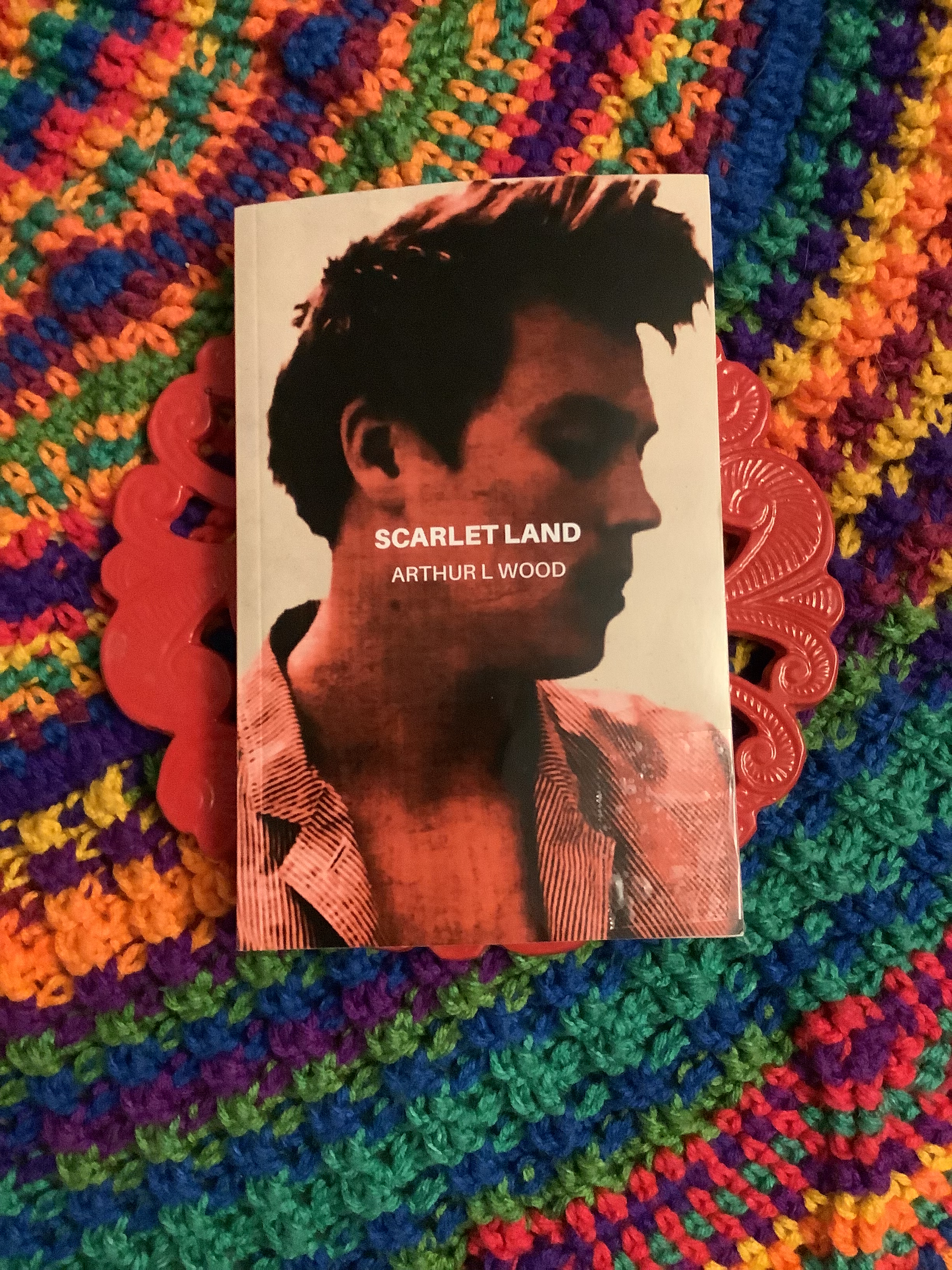
Copyright 2021, Arthur L. Wood, Cover design, Hugh Rochfort
Having read Arthur L. Wood’s first collection of poetry, Poems for Susan, with its tender strains of love poetry and its far-reaching set of influences, one might be at least partially prepared for his second collection, Scarlet Land. Here also, there is sometimes tenderness of language, and the influences, both submerged and spoken of directly, are equally far-flung. But the tenderness here is more tempered with a certain cynicism, an acquired knowledge of more of the world in the tone, a certain sated weariness from time to time in the language, which yet does not make the poetry dull-witted with rancor or wearisome to read.
In Scarlet Land, the poet as a figure has not only the topic of love to contend with; he is also embattled in that same sensation of love, embattled in society, in poetic invention, in many things. And of course, in the background lurks always the awareness, like Rimbaud, Verlaine, Baudelaire, of being a poet in a condition or time of disease: just as in 2020, Covid appeared in Poems for Susan overtly, here it appears more insidiously, in the background as one is aware of the unhealthy influence. There are songs of dismay at modern conditions:
I cannot find my England.  Does she lie in dust I sweep,
Does she hide away in sunshine, in darkness does she creep,
Does she hum a pagan melody and converse with the stars,
Is she frightened by the madness and the music from the bars?
I cannot find my England.
There are poems investigating or betraying to view a poet’s states and choices:
What more can I do?
I've channelled the poets,
I've died so many times,
Yet so few are listening;
I've written ten thousand
Miraculous rhymes--
What more can I do?
**************************
So many great poems!
What more can I do?
Tell me, would you please tell me,
Because I haven't a clue--
I get up each morning,
I shower and dress,
Then die many times;
Another call centre
Awaits me, I guess.
*************************

Or, taking a line through Milton, more affirmatively:

*************************
Let my body starve!
Let my soul rejoice!
I cannot fail my task,
I must be precise!
I'll reinvent the songs
With the trumpet of my voice,
And pave the path of poesy
That leads to paradise!
Raymond Keene, OBE, comments in his Foreword to the book that this is “fraught territory,” and indeed, in this book, the poet allows himself to be used nearly as the canary in the coal mines is used, who is the barometer (if he lives or if he dies) of whether or not there are unseen and dangerous substances being breathed by those around him. It is certainly in Scarlet Land a more “fraught” mental and moral landscape than in the previous book.
As to the structure of the poetry, Wood has always been good at achieving a sense of closure of the poetic material, regardless of whether the poem ends on a refrain, on a variation of a previous statement, or even if the contained sentiment diverges from the poetic shape by not being conclusive. He has also not disappointed in continuing his genius with metering and rhyming, though there are herein a bit more of poems in blank verse.
Sprinkled throughout, though not devoted to any one individual love by name as was the case in the previous book, there are still some hopes given out for the persistence of human love. The characteristic love poem here now occurs in spite of negative conditions, not so much in the absence of them as was the case in Poems for Susan:
While We Love
The world of raging fire,
The cold and dark abyss,
The fluctuating chasm,
Are nothing while we kiss.

The lake of burning sinners,
The acid in the sky,
The hole within the middle,
Are nothing while we sigh.

The steel-whitened seaweed,
The limping one-eyed dove,
The corpse upon the mountain,
Are nothing while we love.
All in all, though the poetic voice is often strained here, the poet frustrated in the extreme to the point of sketching it all out for the reader, we see here a more complicated and mature poetic schema than before. Poems for Susan was an astounding and magnificent book, but it was the poet’s courtship of his subject and his talent; Scarlet Land is the beginning of his alchemical marriage to the same.
Poems for Susan in a seasonal bouquet, Copyright Arthur L. Wood, Cover illustration by the author.
Arthur L. Wood is a young poet from the U.K., residing near Winchester, Hampshire, who is generously sharing his first collection of poems, Poems for Susan, which was written in a few short months’ time in the warm season of 2020, some of his poetical recitals of his poems being on YouTube. But more about that later. He is a widely versed poet (to make a true pun), whom the notable writer of his Foreword, Raymond Keene, OBE explained, has written a work which bars the progress of the destruction of intellectual civilization. This may sound hyperbolic, yet if you’ll indulge me with this post, and try the young man’s poetic skills for yourself, you’ll see that it’s only perhaps a bit overgenerous. In this sense, we wait for what more he will do, because he has made such profit of his early opportunities, that now he may be the only person who can live up to them. As Raymond Keene notes, he has been under the influence of “Baroque and Metaphysical verse,” and Marlowe, Shakespeare, Byron, Blake, Yeats, Eliot, and others. Sometimes, Wood alludes to these poets outright in the verses of his book, sometimes he seems to have swallowed them whole and digested their substance, then integrated it into his work wholesale, a good thing, as it proposes a tradition of continuous poetic involvement. The quality I find most enchanting, however, is the sheer intoxication of words, which to me of all the influences named is the most like Shakespeare at his heights, in the use of sometimes startling verbal inexactitudes which then become new and vibrant precisions for the reader, which is the way true poetry works.
The book begins with “A Preface in Seven Parts,” followed by 70 separate poems of varying meters, rhymes, and subjects, though the overwhelming number are devoted (and I stress that word, devoted, or consecrated, perhaps) to one main subject, the subject of a young love. It is organized and passes through easy stages of poetic awareness, though a careful editorial process seems to have shaped the work into a whole, as if the poems are all parts of one long poem.
Now, just to give a bit of a tempting taste of the treats in store for the reader: The gradually evolving subjects are these:
Of youth and friendship, sometimes under the influence initially of drugs and alcohol;
On those first drugs I ever took
In fields with friends when I was young
With dances of delight and song
And shimmers by the aching brook.

That long and weary journey through
A world of new sensations sweet
Nervous in the dizzying heat
Obliterating on the dew.

Of the threat of madness or emotional instability;

And twice or thrice, I oft forget
I held a knife and slit my arm,
I longed for some enchanted calm
And shook in midnight's fearful sweat.

I struck in anger, sunk in fear
And said, "My life is overworn
I wish I never had been born
I wish to easily disappear.

Of Byronic, Romantic idylls in foreign lands;

I found my soul in lands forlorn
Saw noises in the slow retreat
Of day and grasslands good to eat
And those enlightened fields of corn....

Of the intoxicating influence of love;

I am possessed by something new
A glimmer like that youthful day
But stronger with a brighter ray
And my beautiful Love is too.
Of the depths of love, as eternal;

"And I can feel the holy hours
Build with restless ecstasy
And thus it feels, thus I am free!
And love in life in death is ours!"

**********************************

A wealth of poets throned above
Gaze upon our fledging love,
They gaze, they nod, and wisely see
How love grows to tranquility.

Of the awareness of mortality and potential aging playing against that eternity, signs and portents;

If you look you too will find,
You'll dream the year that you shall rot
You'll see the end of your sweet mind
You'll see the end of your sweet lot.

********************************

I went to the forest to weep,
Then on to the meadow to cry,
Then on to the hillock to sleep,
Then into the grasses to die.
For my Love was an angel I hurt.
I didn't know wherefore or why.
My passion belonged in the dirt.
So I went to the forest to die.

Of the coming of war and Covid, and yet....;

I turn inside.  I turn inside.
India and China go to war
And my dear friend to Covid died.
The world is rich, the world is poor.
I think that every genocide
Was born like this and I can see
And so I'd rather turn inside,
These savage brutes do not hear me.

************************************

I end my sleep
Despite my better judgement
And the pleading of my eyes.

Upon my street three emergency vehicles
Six emergency personnel
One man dead.  Well, everybody dies.

***********************************

Come my way and I will rest
Come my  way and I will lie
On your million-pleasured breast
With coolest fingers round your thigh,
And like an olive softly pressed
Above your touch my swelling chest
Come my way and we will rest
Come my way and we will die.

Of how other realities impact upon love's legislations;

For evil eyes announce that death is slicing soon
Then move with me in passion round this Moon
And fear the loss and fear the fading flame.

********************************************

Of Blakean-style hopes for a fairer world;

When work is a toil for goodness
And food is not murder or theft
And peace and religion are partners
Providing the starving bereft,

When beings of blood are the mirror
And fear and unusual sight
Then I will walk easy in daytime
Then I will sleep easy at night.

Of partings, at first temporary, then appparently more lasting;

My life I cannot lose but moan
For times to come now thou art gone
I lost thee yet we meet again
When there is no more grief or pain
When night exhales the dawn.

Of a final dedication of the poems in the verse;

Our flesh may travel on apart
Our hearts may proudly flee the Will
But where I go, whoe'er I know
I will love you still.

****************************************

The ghostly God is calling me
Clouds are bursting on yon hill
Although I go away to rove
I will love you still.

**************************************
**************************************

When you gaze with a wonderful glee
At Time's mysterious view
Then all your thoughts are with me
And all of my thoughts are with you.

And at last, a sort of realization, hard-won, about the infinity of all beings:

Today is the last of the dancing,
Sigh on, sigh on.
To wherever are we advancing?
Zion, Zion.
This gives only the general outline of the whole volume of poetry; there is so much more in the entire book. At some moments, it’s hard to realize, by the very depths of awareness, of the intensity of successfully communicated feeling, of the intoxication of having so many influences thoroughly combined into a neat whole, that the poet is a younger poet, with much time ahead of him still to compose. True, he has another book out already published in 2021 (which book will be reviewed on this site as soon as I finish reading it, I hope over the winter holidays). It’s a bigger book, which focuses more on the development of the poet, with all his generous, gentle, scintillating and perceptive poetical tentacles out during the world’s ongoing Covid pandemic. The title of that book, in case you want to order the two at the same time, is Scarlet Land. Just to give you a short taste of the continued loveliness of his work, here is one of the short poems therein:
Untouchable Hand

All nations go to the dogs,
The oceans size up the land,
The eyes are desolate nerve endings,
The rocks are grinded to sand.

The winds are endlessly blowing,
My heart is still overflowing,
And those joyous embers are glowing
In your warm, untouchable hand.
As an added attraction to this book of poetry, Poems for Susan, you can listen to a YouTube audio recording for free of the poet, who is marvellously trained as a reader, reading some of the key poems. This is the link: YouTube.com/playlist?list=PL2z5ZyeiuCJTM3XyTzrQyKx4T1EI9qaVM. Or, if you’d like to hear this same poet read not only from some of his own works but also give his considerable talent to the deliverance of other poets’ works, you can seek him online at Poetry from the Shires. If you wish to contact him, you can email at arthurwoodpoetry@gmail.com. Last but not least, the shop address you correspond to online if you want to order either one or both of his books is:
May all my and Arthur L. Wood’s readers have a wonderful season this year. Some of us have already celebrated an early Hannukah this year, but there are still Solstice, Christmas, Boxing Day/Kwanzaa, and New Year’s to follow. Please enjoy yourselves sensibly as regards not only your indulgences, but also your Covid precautions, so that as few of us as possible have things to regret when the season is over. Be Happy!
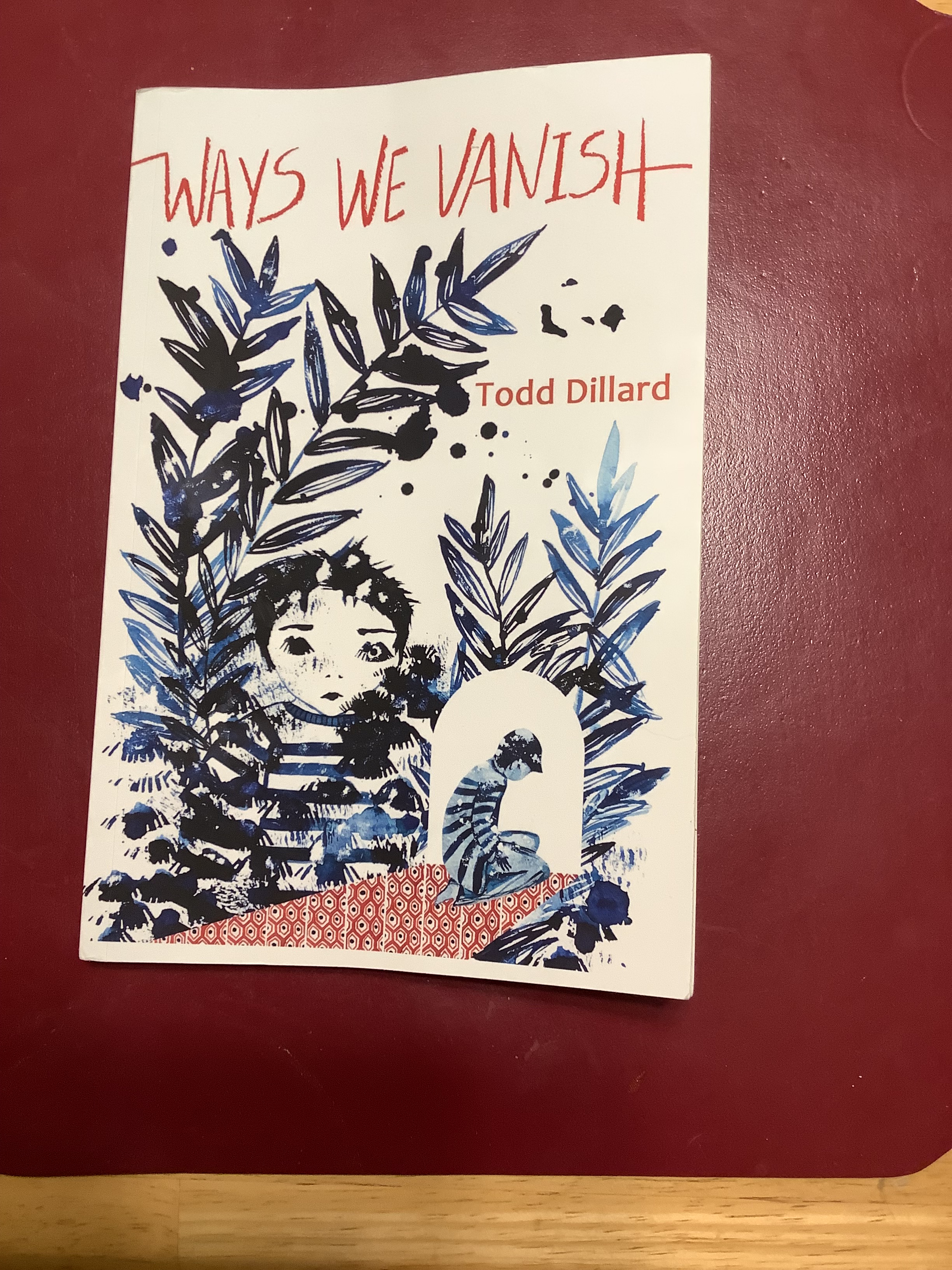
Todd Dillard’s book “Ways We Vanish,” published by Okay Donkey, Cover Art: Sarah E. Shields
One of the hardest things for a reviewer to do is to select out the particular and most essential things which set any work apart from others within even just our own memories, or to perhaps find adequate words to paint pictures of words, not to mention taking account of any that others we’ve read might have isolated for attention. So, reviewers may decide that a particular line or phrase, an image or even a whole poem deserves to be quoted. Gven my own lack-and-well-a-day penchant for the hauntingly and suddenly rhymed, pointed line in a piece where nothing else rhymes, I could select lines from Todd Dillard’s book Ways We Vanish such as the final lines from “If You Are What You Eat Then Today I Am a Flood on My Mother’s Death Anniversary”: “I too have let a child splash in rising waters/just to watch them run home, shivering, to me./I too have left the front door open and invited in the sea.” Or, eschewing that tactic, I could pick the whole of the poem “Scratch Offs,” in which the governing metaphor is that of scratch off tickets, and the poem covers the track of time, of birthdays and whether and how much things from year to year change or stay the same. But this work–though it comes in two separate books, and there are differences between them–functions moreso than some as a whole on the single topic of a life celebrating, coping with, and sometimes intensely grieving, family love. There are more incidental poems, but they seem to operate as isolated moments, moments of freedom from the overwhelming, moments of curiosity about the outside world which can be spared from family life only occasionally.
First and foremost, this is a book of much spiritual and psychological cleanness, not versus being dirty or underhanded, but in the sense that it has a very special sort of subtext. Usually, when people say “This has a subtext,” they often mean “This has an ulterior motive,” or “This has an anterior, hidden meaning,” and often they also mean “which I don’t entirely like.” Others simply assume that everything has some sort of hidden/dishonest subtext. Here, however, if Ways We Vanish has a subtext, it is an exciting one, for poetry, because the “ways we vanish” are ghostly in the sense of being “ways we manifest,” the “ghosts” not being only the beloved dead and the past and gone moments that are manifested, but the living and present and in so far as the future is spoken of at all, even that. All are luminous with their own manifestation.
The ghosts are very alive here, because the beloved ones always have a place, whatever pain has gathered about them as they lived or are living, and though I wouldn’t like to suggest something possibly sentimental or maudlin about a book which has such a clean, tight texture to its poetic stories, there is the same sort of sense in it of the dead persons as well as the dead moments still having a place in one’s contemporary history as there is in Wordsworth’s poem “We Are Seven.” The difference being, of course, that here the voice speaking is one of an adult who knows the reality of death, not that of some “simple” country maid being interrogated in the Romantic haze of an elderly statesmanlike poet.
One of the poems I liked the most from the book is “Love Poem to My Brother As He Gives Our Father a Shave,” a poem which pictures two brothers with their father in a hospital room. There is a comparison made about the sound of the scraping blade on the father’s cheek which is one of the loveliest and most touching I have ever heard: “..that sound,/follicle scraped from flesh,/like tearing open/an envelope–its letter/good news–it says/you are alive/and the ones who love you/most are here, touching/your knuckles, wrist,/as if there grows on the body/a kind of Braille–“.
In fact, in general, the book is even at its most intellectual moments not a hidden text which one must decode and decode again; rather, it is a rough wolf’s tongue lick to its cubs and its mate as a sort of vade mecum into the true realm of poetry, the interior places where grows the root of poetry: fellow feeling, family feeling, and creature feeling, such passages as those sharing tears and laughter with a small child: “my laughs love and mourn and see/they are like living that way.” Here is a poet who is not afraid to say such things in the poetic voice, because they are from the excavations of the sometimes long-buried human voice, and he knows it. And in reading this book, we too can find ourselves and our loved ones again, however long and away the time has been since we last were able to think in this way and say these things ourselves. Rather, here Todd Dillard says them for us, in the saying of them for himself.
Copyright Matthew M. C. Smith, 2018, 2019, Black Bough Press in association with KDP Ltd.,
Matthew M. C. Smith, the editor of Black Bough Poetry in Swansea, Wales, has reissued his 2018 book of poetry, the modestly entitled Origin: 21 Poems. It is his first collection of poetry in a long life of working on poetry and studying poetics. One of his first contributions to the body of work on literature is his doctorate at the University of Wales, a thesis on the poetry of Robert Graves. Currently, Matthew divides his time amongst a career in work on anti-poverty, education and welfare work; an editorship at Black Bough Poetry/Barddoniaeth Y Gangen Ddu, and a new volume of poetry, all of which makes him truly a Renaissance man.
When I had finished reading Origin: 21 Poems, my first thought was that if I weren’t talking about poetry, I’d say that each of these poems is clinically exact, except that I am talking about poetry, and “clinically” is the wrong word; these are poems rich in feeling, fellow-feeling, and emotional wealth, and here the poetical indirections are made in short, minimalist code of metaphor and description, which perhaps has confused my own non-minimalist poetic practice.
This poetry is definitely something to learn, and to know how to do, for the beauty of the sometimes staccato revelations is extreme, the phrasing a sort of condensed shorthand on the road to perfect portraiture, to individual epiphanies, to separate visions.
The book Origin: 21 Poems is entirely situated around family situations, cultural ones, and natural/mythological/religious ones (all those things in life that are so much bigger than we are), sketching a line from belief and belief systems through the societal structures and remnants of ritual our civilization has left us with to family and celebrations of family and faith, the most personal of all.
There are careful pairings of poems back and forth, weaving, knitting a net to catch us in, with the warp in one poem being a salute to air travel, to being a soldier, either modern or ancient, and the woof of the next poem following being a loving meditation dedicated to a child’s birth or to play with children, or, one of the most moving poems, a poem on the death of the poet’s father, containing some of the implications of his life. There are poems on prophets and guardians and “prodigal” women, nature poems filled with the beauty of winter or the symbolic natural growths of the seasons, and the book ends in a tribute poem to another Welsh poet, Alun Lewis, who died in WW II. There is no accident here in these weavings of opposites, because they not only thus form Smith’s dedication to being a participating witness in all the doings of life, but they also invite the reader to select favorite and most resonant phrases, to read aloud, and then willy-nilly, to be led into a different experience, just as life itself would demand. Here are some of my favorite lines and their topical sources:
the birth of a child: “You belong to the world/to rose-red rivers dipped by the sun/to the white path of light in darkest night/ to frosts of fire beyond our dawn”
the death of a father: “No cry, nor whisper, a cross shape/near crested roar and the people you love/carried you from the shore”
“After Man”: “The fern, the ivy/the circle of oaks/were fast losing names given…our time was terribly mocked”
the modern soldier; “Men of arms…frame-ache, sting of sweat/body-rack past forest tracks/where whippet-lads lead/and bigger lads wane”
“The Moment”; “cycles of sun and/nights of stone//Picasso/his sorrow of shadow/is cast across/a frieze of terror”
the poet’s homage to another poet: “your words grow old/but dare not fade/I heard they took you/in feathers as light as snow/and in that whirling flight/as words exhaled/they kissed your fading glow”
Here, the taut exactitudes I have spoken of in my title are from line to line, but blossoming forth in between are the pictures, the images, bodied forth in and contained by the lines themselves. The overall effect? Almost a contradiction in terms, the lyricism of the burgeoning phrases, held firmly in the short precision of the actual words. Thus, it should be no guess that the preference at Black Bough Poetry is for short, imagistic poems of 1-10 lines, and that the devotion to the human equation has produced a sense of community for poets of every stripe, who are regularly invited to participate every Tuesday online through Twitter, tweeting to Black Bough Poetry, in #Top#Tweet#Tuesday, a rollicking, fun-filled poetic experiment in exposing poets from all areas of the globe to the work of other poets of all kinds and schools. As well, there are occasionally special seasonal contests and participations, such as the recently closed one for Hallowe’en 2021.
As a final and defining note about this poet’s, Matthew M. C. Smith’s, contribution to the world poetic community, I would like to call attention to his election this month (November 2021) to be Broken Spine’s #Writer of the Month. Already, he has participated in more than one poetic activity in this position, all of which information is available to the interested follower on Twitter. If you are not yet familiar with Smith, his book is available on Amazon, and for all the many poets the world over who are already friends, admirers, and poetic colleagues of him and his welcoming, modest and self-deprecating humor, let’s give him another round of applause, and keep reminding him we are eagerly and a bit impatiently waiting to read his next book. I mean, for a man who has so little else to do! Seriously, though, be watching for Matthew M. C. Smith’s next volume of poetry; to judge based on this one, it’ll be another wonderful poetic experience.
With cavewall sonnets, it is necessary to speak of an ancient bard or ancestral voice intoning rich, mysteriously rich and tantalizing if sometimes evasive syllables. My feeling after reading through C.T. Salazar’s book American Cavewall Sonnets several times is that I will have to live a long time with this book before I feel I really understand these poems at all as thoroughly as they deserve; but don’t understand me to be complaining. From the beckoning and lush art of the front cover–what one has come to expect from Bull City Press’s chapbooks, here the cover art being Wildstyle Still LIfe by Collin van der Sluijs–the story of the poems is one of equal lushness, richness, elliptical at some points, but a straightforward celebration and reveling in language. If you’re expecting the rhyme or meter of a traditional sonnet, don’t: though some of the lines have distinguishable meter, it is intermittent and tends to occur in first lines where it does. The main sonnet constraint (and here, in the glory of the unrestricted experiment it would be a constraint to expect a formal sonnet) is that each poem is 14 lines long, 8 lines followed by a separate 6, and in one case, a visual poem of two recurring words, even that form isn’t strictly adhered to. But trust me, if you give these poems your time and heartfelt participation, it won’t matter a jot to you if the traditional sonnet is left totally in the dust for this spell of poetry.
Thus, formally speaking, this book of poetry is not a docile housemate, though sometimes a frenzied one; it is never reallly indecorous or disrespectful, however. It respects first of all the internal distances between reader and poet, and negotiates them without rapine or plunder of the reader’s resources. What do I mean by all that? Here’s an example:
"The rifle scope was a failure indeed
of the imagination--look through there
and everthing becomes           a target."  (p. 13).
From this, one can see that while the poet has no intention of allowing his poems to be the target, to succumb to facile interpretation, the reader is welcomed into the lovely disorder and chaos that do aim towards meanings, but multiple meanings, as toward multiple–no, not targets–but caresses of the imagination. These are gentle, yet serious touches on the reader’s arm and consciousness.
The moments of darkness are not denied, the ones that keep humans sheltering in their illusions rather than facing what confronts them. “I never talked about what I saw in the river: /the humans who drowned.” The “mosaic” of our moments of darkness and also of belief is the mosaic “made from the salvaged chips of empire.” (p. 10)
And the force of memory in this consciousness, one which the poet tries to bring the reader to expand and to share with him, takes its turn too in the book–thus not only the target has been magicked away, but time cannot lose its soul to passing, and permanence becomes conceivable as more than a dream:
"This room was no longer, so I put it
back together/I put it back in my
mind/I put it in the back of my mind....
At the end of the world I'm told
a prayer could harden into a full
moon bright enough to guide our fathers back."  (p.27)
It’s not a matter of self-deception, though. In the ellipses I have placed above, the fragility of a broken vase is mentioned, and in the following line just below, we are told: “Even a whisper can bruise.” In such a world, wherein the poet must mediate and (once again) negotiate for himself and others, Salazar positions the poet in the most human and resonant of places: in the juncture between fragility and breaking and constancy and wholeness, we are finally told, as the summation of that sonnet and the book, “love, touch me.” And that sense of trust in our human capacity amid the challenges which may overwhelm us at any moment is a sense of trust in the bond, too, the compact, between poet and reader.





 creativeshadows