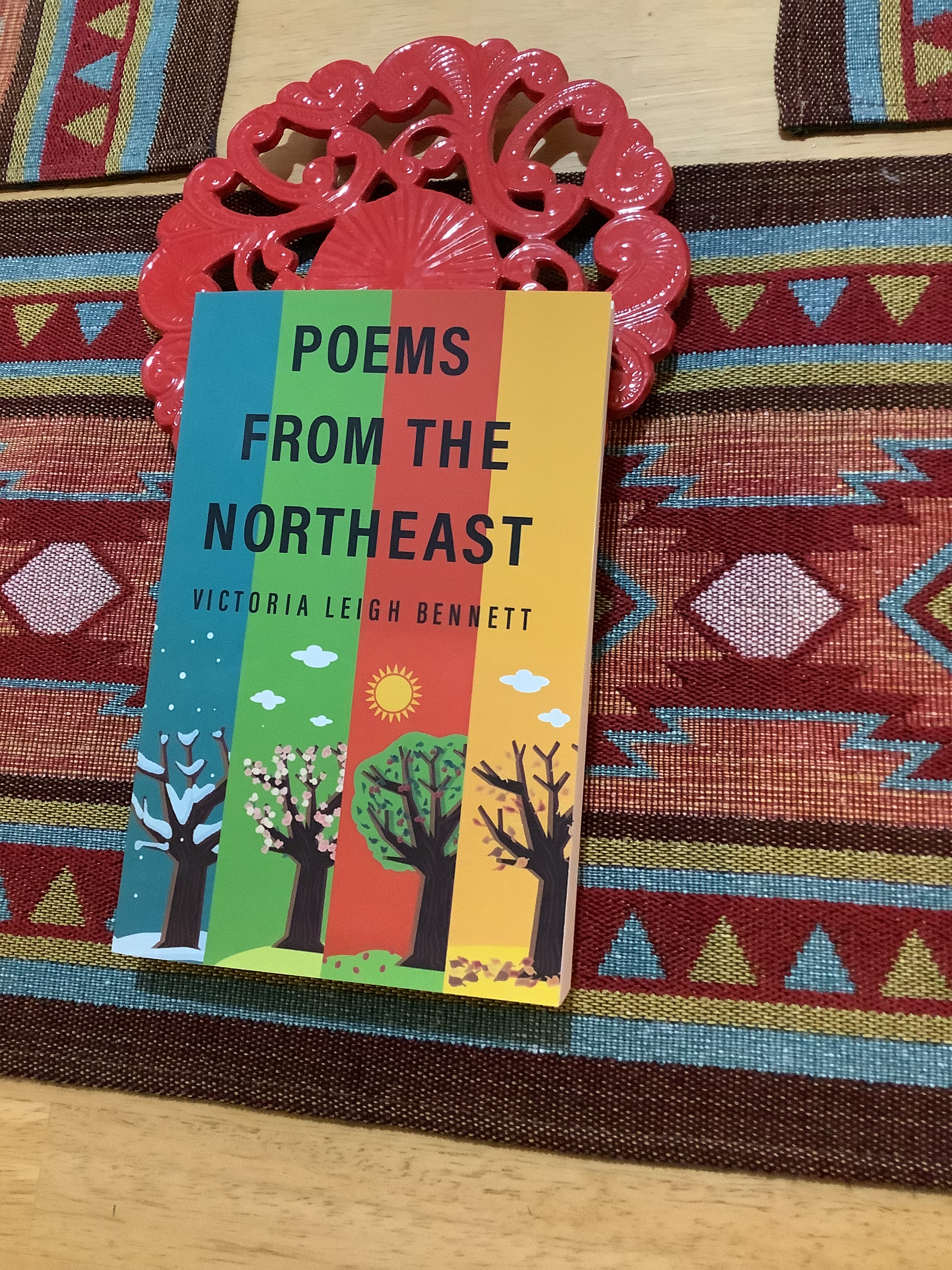
I have recently received notice from my British publisher, Olympia Publishers (Twitter: @olympiapub) that my 2021 poetry book “Poems from the Northeast” will be remaindered and relevant copies pulped, now in about 10 days. If you are in need of a copy, for 334 pages of all of it, you can obtain it from Amazon platforms (in U.S., $14.95 plus shipping & handling; Book Depository of an earlier notice is now no longer in existence). You can also get it on Kindle, or from the UK publisher directly if you’re quick, at their website (see on Internet through Google). Thank you for your patronage thus far, and happy reading!
The front cover of “Cajoncito: Poems on Love, Loss y Otras Locuras” in paperback, by the author.
Cajoncito [A Little Drawer]: Poems on Love, Loss y Otras Locuras [and Other Follies]” is a book of remarkable poetry by Elizabeth M. Castillo, a British-Mauritian poet living in Paris with her family, who has also lived before in Chile, Mauritia, and the DRC. She is widely published in various languages in which she composes, notably English, Spanish of two countries, and French. My introduction to a smattering of her poetry in English two years ago was through Twitter, where I first encountered her work. At long last, when her second book, Not Quite an Ocean is now out and being read, I find the first still holding its own in the warp and woof of my poetic memory (to use an artistic image as much as possible in the manner of the ones I admire in her work). The first book is a tribute as well to her life with numerous other people whom she has loved, and some of whom she has lost.
Her artistic words are ordinary and simple if multitudinous and mightily creatively used words for passion, and feeling. Not only do words in English and Spanish–only the first of which I came to the work knowing more than a smattering of–respond easily and richly to her call, but they say things, visit emotional places one may have felt, but never known how to have put in one’s emotional passport legally.
The territories and lands of the transgressions against love and the grief resulting, as well as grief and longing drawn from other sources crafted for life, are painted here in vivid language colors, sometimes in matched, paired poems in which some words of Spanish in one and English in the other are reversed, sewing the two bright place languages together like the covers of a book of poetry.
There is too much to quote, too many inspirations to follow down the corridors of the heart of this poet’s work: you have to read it for yourself. Before, I have always been a curious but casual peruser of the Spanish version of the English bus and other public announcements on American walls and ceilings, attempting in my primitive way to match the correct pairs of words. For the first time, but I hope not last, I meet the natural aristocracy of someone’s language who has mastered both, and who can vary them back and forth easily at will, making of them in her matched sets of poems a wife and husband completing each other’s sentences, interrupting, interjecting, but always in complete agreement for the reader, who only has to locate the translated portion in the matching poem to learn “for sure” what the “foreign” phase or sentence means. And learning in any way at all is always lovely. And it’s there that the virtue and smugness of “knowing for sure” is also trickily understood in all life ventures to be a form of foolhardiness and loss except in love with life and language, which have in some way to make their declarations of certainty for the time in spite of really not knowing, as the poet more or less outright states she would have it. I find that I almost begin to understand instinctively portions of the Spanish from this gentle and loving example of what used to be called “immersion” learning, as if in the hands of a dedicated and talented tutor or teacher.
Castillo’s major poetic virtue, and she has many, is thus her comprehensive expressiveness and rich texture of images and references to simple enough things about life that become complex again as she puts them in words. One feels almost as if one oneself is becoming gifted enough to understand a new and alien language about life and its doings and “loves, losses, y otras locuras” (as she puts it in her title).
Finally, the greatest reader’s gratitude I have for Elizabeth M. Castillo as the author of the book is that she makes me stretch myself and my own experiences over the framework of her embroidery hoop to be needled and pierced by her lovely work, a set of images and feelings that I never knew I needed so badly before she created them. Please buy this book and read it soon, and then buy Not Quite an Ocean to see what she is doing!
8/5/23, by Victoria Leigh Bennett (shadowoperator)
The cover of Lawrence Moore’s “Aerial Sweetshop,” published by Alien Buddha Press.
Lawrence Moore, who has quite a bit of recent work published in a number of reputable and well-respected places such as Indigo Dreams and Dreich Magazine, and whose Twitter handle is known by many as simply @LawrenceMooreUK, is frankly unassuming as are many poets, and has patiently waited a year exactly for this much-deserved review, while the reviewer dealt with life and its turmoil. I am delighted at last to be able to bring it to my readers. Aerial Sweetshop, though dedicated as a devout tribute “For Dad,” a flyer of planes both full-scale and model, is actually an experience for every poetry reader, whether a rhymed verse addict (where Lawrence’s work shines) or one of those who prefer blank/free verse.
Moore’s verse is one distinguished in substance by melodic, singing rhythms even when not in rhyming verse, and by kind and altruistic notions. Its subjects are those of mysteries and magic, love poems, and always the sky, and looking up and flying (in both of their literal and metaphorical meanings). Its images are drawn from changing landscapes, the landscapes (when not of pure sky) both actual and even more often those of pure imagination, metaphorical landscapes. The loving rhetoric is one of both faith in a single companion’s human goodness, as well as in the charms and chances of harmless mutual mischief. The villains of the piece are responsible for submerged notes of fear of prejudice and unjust punishments, but are overcome by the claims of gentleness and the strength of togetherness. The one exception (and I’m not sure the female figure leading the narrrator in “My Ardent Friend” can actually be called a villain, in any plain sense) is one who leads on to a sort of accepted ritual or initiatory ending, which is not exactly an ending. Ah! A curious mystery to lead us in and on!
There is a temptation with the rhymed poems, because some of us have grown up familiar with or at least exposed to end-rhyme poetry, to jog-trot the wonderful meters and jar the end-rhymes, but in both the other poems, the blank/free verse poems and the rhymed ones, the rhythms change sometimes unexpectedly and stop that bar to good poetry from taking place. In those cases, if you get too caught up in the sound, you risk missing startlingly lovely and human senses in the poems, such as:
1). p. 9–“don’t let the busybodies ask you why/when they mean don’t…”
2). p. 26–“and if you snore all day/and talk while chewing on your food…”
3). p. 39–“The big wide world is interesting;/you are my greatest adventure.”
All in all, this chapbook is so worthwhile that it hardly seems a first effort at publishing poetry. It contains most nobly, generously, and lovingly a poetry that makes its own happiness, with the inclusion often of a pertinent and essential “other,” a rescuer, guide, and companion in the pieces. In conclusion, Moore’s book is a true “aerial sweetshop,” or as an American like me would perhaps put it, a “heavenly candy store,” full of all the sublime things and beings the heart most wants to have.
In his marvelous collection of sonnets on Buddhist thought, inspirations, and images, sonnets from the dhammapada, the impressive and practiced sonneteer Alex Guenther applies some of fthe same methods, skills, and sensitivity as he consistently does in all his sonnets. A main difference here is that, as he credits in his introductory pages, he is drawing on other works of translation of Buddhist teachings, most notably that of Gil Fronsdal, with whom he feels a great sympathy and in whom he senses a kindred spirit, as he records. But the rest is all his.
Guenther–as he has done in his previous two books, the deodar seeds and the heave, which I have fortunately had the opportunity and privilege to read and review, and as he has continued to do in his later collections and his multitudinous and multifarious daily output, many of which I have been lucky enough to encounter as he has tweeted/posted them on Twitter–is an entirely and shockingly unique artist, but a great one.
He reaches for a topic and topics aplenty he finds to hand, relating as always to the Buddhist practices, virtues, and outlook, which non-practitioners may find strange or alien to things already familiar and known or perhaps contemplated by those of them in his audience. By this method, making the strange or unusual more familiar and understandable, he shows how great a teacher he really is, in a belief system full of great teachers, for this is his belief system as well as the source of his own inspiration. It is not surprising to learn that he is also a literal and down-to-earth teacher of young people in “real life” as well.
In his teaching by sonnet, Guenther brings clarity to any obscurities in Buddhist thought (for example, his sonnets among the “26 Pali chapters” which he calls “the most well-known Buddhist text” are: “filters” through which we construct our realities, “awareness,” human vagaries of thought, foolish people and their opposite, the making of “the wise,” “evil,” “violence,” “old age,” “the self,” “the world” in both the physical and social senses, “happiness” “pleasure,” “anger,” “the just,” “corruption,” “the path” (as in “the way”), “hell,” “the brahmin,” and images important to the original writers, such as “flowers” and “elephants.”
In addition to being a steadfast believer and teacher of Buddhist thought, however, Alex also teaches by example in his wonderful and extremely talented and innovative usage of the Petrarchan sonnet, just as he has done before, and continues to do in many varied ways. He has massively and manifestly increased the territory of the sonnet form by his general use of diverse and attention-getting, witty, original rhymes; his non-end stopped lines that spill over into the next line by sense, thus making the reader read for this sense and significance more than for a dogtrot sound; and the vast, encyclopedic knowledge he shows not only of people, but of the world and its scientific, artistic, architectural, and natural biological properties. Alex Guenther maintains in his daily life quite obviously a system of keeping up his own learning through his curiosity and willing approach to what the world puts before us that can be learned.
In concluding this review essay, it could well be said of Alex Guenther as of another–modest, unassuming but quite ambitious to find, celebrate, and share wisdom wherever it may be–the Clerk of Chaucer’s Canterbury Tales–and here I translate from Middle English into Contemporary English: “And gladly would he learn, and gladly teach.” We need so many more Alex Guenthers, poets, teachers, and explorers!
Alex lists as “additional info and links” in his book, these: alexguentherpoetry.wordpress.com, twitter.com/guentheralex [@guentheralex], facebook.com/alex.guenther.104, instagram.com/guentheralex.
I think he also is on substack (you can query him at twitter), and has been on Mastodon at least previously as @guentheralex@mastodon.social.
Come learn somthing significant and worthwhile in beautiful and well-crafted language!
This review by shadowoperator (Victoria Leigh Bennett)
This novel is back from a bit of a hiatus with a considering publisher; it’s now back on this site again with the other 8 (the 7 in the same series plus the standalone novel The Declensions of the Wild Wood). Feel free to dip into it at your leisure. It like all the others is copyrighted. Shadowoperator (Victoria Leigh Bennett) 2/12/2023
This is my long-awaited (by some) and much worked-upon (by me) 9th novel.. It is the 9th one I’ve written, though it is not continuous with the other 8, nor is it a part of their series, which was thematically inspired by the I Ching. This novel is perhaps my most ambitious so far, as it deals with topics, several of them, which I have never attempted before. To the end of accounting for some of these things, in case my handling of them should seem irregular, I acknowledge the previous work, which I have read about, of Peter Wohlleben, Suzanne Simard, “The New York Times,” “The Wall Street Journal,” and “The Smithsonian Magazine.” As well, I beg the indulgence and tolerance of the Canadian Ministry of the Interior and the Toronto Parks, Forestry, and Recreation Division: I have taken what are perhaps gross liberties with the little amount of research I was able to do online about their operations, and have more or less fantasized about what it might be like to become a Canadian citizen from a previous situation of overwhelming stress and difficulty. Though I would at one point have very much liked to have been a new Canadian, I was there in Toronto in a relative situation of ease. Though often short of funds, as most graduate students are from time to time, it was for education I was there, and I enjoyed many privileges thereto. I have written partly of locales and businesses past and present of which I was aware, but there are others which again are totally made up from a sort of composite knowledge of some situations in large cities in general. Toronto is without doubt a world-class city, and so I have made bold to assume that it must have many of these same characteristics as other world-class cities. This is all really, except to perhaps apologize for my heavy reliance on Google Translate for what I wanted to have my characters say in Ukrainian and Russian: I doubt it’s all perfectly accurate, but I have taken care to add nearby English approximations so that if a closer translation ever becomes necessary and possible, I myself will at least remember what I was trying to have my characters say. Finally, but not the least, I offer my welcome and hope that any Eastern European readers from any country following this story will forgive me if it seems to them at all inaccurate or unfair in any way. Years ago, I lived along St. Clair West in Toronto, as I had lived also in other locales there, and I was surrrounded by a largely Eastern European culture. I have borrowed what I remember of their speech patterns and their ways of dealing with each other, and I hope I have done so fairly accurately and not unjustfiably, though I know many things may have changed. I have been following the course of the Russian attack and war on Ukraine, and many may wonder why, if I am in basic sympathy with Ukraine, I made my main character only half Russian and half Ukrainian. It was definitely more of a challenge. But at the time when I started the novel, in Fall of 2021, I had less than no idea that Russia would be attacking, and I was writing purely from a standpoint of an interest in what had been said variously about the United States and more Northern climes in relation to ecological concerns. The novel was started in Fall of 2021, and then suddenly in February 2022, when Ukraine was attacked by Russia, it became necessary somehow to reframe my chapter on “wilding” in Russia a different way, and so I waited from February until October 2022 finally to finish the book. I feel that things have come to such a pass that the book requires to be complete and to find friends now, and to find friends for the right causes, and that a just and fair peace for the sovereign land of Ukraine is one of the morally ecological issues involved. So, I have thus written, and as I have ended my novel at a non-finale point, it bears the legend at the cessation of text: N’EST-CE PAS FIN. Possibly bad or incomplete French, but the thought is there. And so I hope it is, that this bizarre old world goes rolling on for many a millenium to come. Best, Victoria Leigh Bennett (Shadowoperator)
Hello, fiction and reminiscence fans! This is my novella, which is only recently out-of-print and which therefore I am putting up here. I still have 3 copies paperback to sell, if you want you can DM me at my Twitter account @vicklbennett for instructions and cost. But this is my opportunity to make it available as a work of CNF (creative non-fiction, i.e., memoir) to a wider audience. I hope you will enjoy it, and will simultaneously consider of the adventures recorded within that I was only seventeen years old. With no further ado, here it is:
Cover photo and Frontispiece Artwork by Editor Red of The Alien Buddha Press
September 26th, 2022–Hello, Readers, Writers, Poets, and Meanderers! Finally, I’m able to share with you these stories from the days when I was first seriously pursuing a writing career. They are in some cases more extremely professional-seeming and complicated in ethos, structure, and compositional traits than ones I’ve written since, and are, I think, still very much worth reading. They show me as I was when I had first absorbed the so-called “rules” of writing good fiction (and we all know there really are none but just what happens to work). As a result, they may seem a little precious or pretentious to some, but to others will seem better than much more recent things. To quote briefly from my author’s bio found on this site, “[they] concentrate[] on giving pictures of different kinds of individuals in different walks of life, with all their foibles, prejudices, and suppositions about life intact. It is not a book which focuses much on providing the author’s own insights, ideas, or feelings, but upon showing these character types with all their thoughts, experiences, and interpretations of these experiences exposed.” That’s enough of a prelude, I think. I hope you will enjoy them! Victoria Leigh Bennett (shadowoperator)



 creativeshadows